Written by Marcelo Guerrero Oquendo, Co-Owner of Galapagos Insiders since 2015. Last updated May 2026.
We're Ecuador-based, and we've watched every species on this list in the wild. Here's where to find each one, when, and on which boat — with the guide who actually has the bandwidth to slow the group down.
Talk with an expert insider — we'll match you to the right wildlife cruise in 24 hours.
USA & Canada 1-773-280-9571 · Ecuador +593-987-004-404 · [email protected]
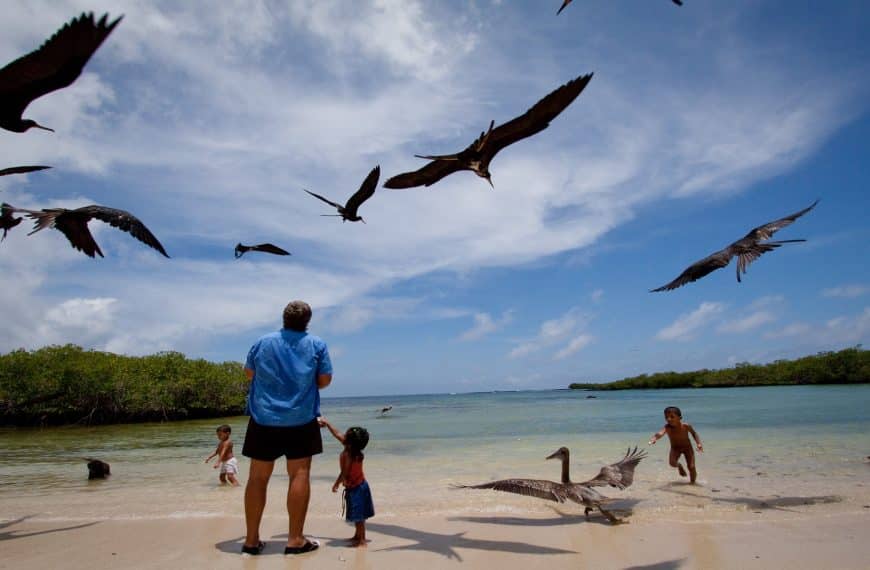
The best Galapagos wildlife tour is a 5- to 8-day cruise with a two-guide upgrade on an itinerary that matches the species you came for. Eastern routes (Española, San Cristóbal, Floreana, Santa Cruz, North Seymour) are the strongest for seabirds — waved albatross, blue-footed booby, Nazca booby, frigatebird — and for the most reliable land-iguana and giant-tortoise encounters. Western routes (Isabela, Fernandina) are the strongest for marine wildlife density — flightless cormorant, Galapagos penguin, marine iguana, large pods of green sea turtles, Galapagos hawk on lava fields. Northern routes (Genovesa, plus the dive-only liveaboards to Darwin and Wolf) are the seabird-cathedral and the whale-shark route. Most wildlife-priority travelers see 12–14 of the Big 15 on a single 8-day cruise. We book Galapagos wildlife cruises across our portfolio of 38 GNPD-licensed vessels for 2026. Fleet-wide minimum-departure rates start from USD $1,530 (Budget), USD $1,816 (Mid-range), and USD $2,065 (Luxury), per person, double occupancy — these floors apply to the shortest 3-/4-day promo departures; a typical 8-day cruise runs roughly 2× these floors.
Every sighting frequency below is sourced from our own GNPD-licensed naturalist-guide logs across 2024–2026. Not from generic operator marketing.
These are the 15 species most travelers ask us about by name. The table is the quick read; the by-route and by-month sections below are how you actually plan around each one.
| Species | Best route | Peak months | Best site | Endemic to Galapagos? |
|---|---|---|---|---|
| Waved albatross | Eastern | April–November | Punta Suárez, Española | Yes (breeds only on Española) |
| Blue-footed booby | Eastern + Western | Year-round; courtship May–June | North Seymour, Punta Suárez | No (breeds widely on the islands) |
| Nazca booby | Eastern + Northern | Year-round | Punta Suárez (Española), Genovesa | No |
| Red-footed booby | Northern | Year-round | Genovesa (Darwin Bay, Prince Philip's Steps) | No |
| Frigatebird (great + magnificent) | Eastern + Northern | Year-round; courtship Mar–May | North Seymour, Genovesa | No |
| Flightless cormorant | Western only | Year-round; nesting Jul–Oct | Punta Espinosa (Fernandina), Tagus Cove | Yes |
| Galapagos penguin | Western (mostly) | Year-round; cool season strongest | Bartolomé, Punta Vicente Roca, Isabela | Yes |
| Galapagos hawk | Western + Eastern | Year-round | Punta Espinosa, Española, Santiago | Yes |
| Marine iguana | Western strongest; everywhere | Year-round; mating Jan–Mar | Fernandina, Punta Suárez, Santa Cruz | Yes |
| Land iguana | Eastern + Northern | Year-round | South Plaza, North Seymour, Santa Fe | Yes (3 species) |
| Giant tortoise (wild) | Santa Cruz Highlands | Year-round; June–Dec wettest = active | El Chato Reserve, Cerro Mesa | Yes |
| Galapagos sea lion | Every route | Year-round; pups Aug–Nov | Champion Islet, Gardner Bay, Cerro Brujo | Yes (subspecies) |
| Green sea turtle | Every route | Mating Dec–Feb; nesting Jan–Apr | Punta Vicente Roca, Bachas, Bartolomé | No |
| Galapagos fur seal | Western + Northern | Year-round | Puerto Egas (Santiago), Genovesa | Yes (subspecies) |
| Hammerhead shark (snorkel) | Eastern (San Cristóbal) | July–October | Kicker Rock | No |
Endemism notes follow the Charles Darwin Foundation species lists. Daily-visitor caps and 2-metre wildlife-distance rules at every site follow the Galapagos National Park Directorate visitor-rules. The Big 15 framing is GI editorial — we built it from the species our travelers ask about most often by name across multiple seasons of trips with our travelers.

The single most important wildlife-planning decision is the route, not the boat. Two travelers on the same 8-day cruise will see the same wildlife. Two travelers on different routes will see almost-disjoint species lists. Pick the route, then pick the boat.
For the day-by-day routing of each option below, see our Galapagos Cruise Itineraries 2026 page — that's where the route × wildlife matrix lives at full depth.
Eastern itineraries hit Española, San Cristóbal, Floreana, Santa Cruz, and North Seymour. This is where waved albatross breeds (Punta Suárez, April–November). It's the most reliable route for blue-footed booby courtship at North Seymour, frigatebird display flights, and Nazca booby colonies. It is also the route for wild giant tortoise in the Santa Cruz Highlands at El Chato Reserve. The Eastern lee side keeps seas calmer than Western, which matters if your group includes kids 8–12 or anyone who knows they get seasick. Hammerhead schools at Kicker Rock (July–October) are the marine-wildlife marquee for this side.
Western itineraries hit Isabela and Fernandina, plus the central Santa Cruz transit. This is where the Cromwell upwelling drives the food chain: flightless cormorant nesting at Punta Espinosa, Galapagos penguin around Tagus Cove and Punta Vicente Roca, marine iguana grazing underwater on Fernandina (the most untouched island in the archipelago), large pods of green sea turtles, and Galapagos hawk hunting on the lava fields. There is more swell on Western, especially July–November. The wildlife density is unmatched.
Northern itineraries reach Genovesa Island — the seabird cathedral. Red-footed booby, Nazca booby, great frigatebird, storm petrel, short-eared owl. Genovesa is one of the only sites where red-footed booby is dependable. The Northern liveaboard window also includes the dive-only Darwin and Wolf trips — that's where whale sharks are seen July–November, but those are scuba-only liveaboards, not standard wildlife cruises.
If you want all 15 of the Big 15 on a single trip, you need 11–15 days. The 8-day boats that "combine" Eastern + Western do it by skipping the strongest sites on each side. We're open about that at booking. For travelers with the time, a back-to-back Eastern + Western (or a 15-day single itinerary) is the only way to get the seabird breeding sites of Española and the cormorant + penguin of Fernandina in one trip.
Wildlife in the Galapagos is year-round. What changes month-to-month is which species is breeding, displaying, nesting, hatching, or arriving with the cool-current upwelling. The matrix below is what we use when a traveler tells us "we want the booby courtship dance" or "we want hammerheads" — we work back from the species to the month.
| Month | Marquee wildlife event | Best route | Cost tier |
|---|---|---|---|
| January | Marine-iguana mating display; sea-turtle nesting starts | Eastern / Western | Mid-range to high |
| February | American flamingo nesting (Floreana); warmest water; sea-turtle nesting peaks | Eastern / Western | High (peak) |
| March | Marine-iguana hatchlings; frigatebird courtship at North Seymour | Eastern / Western | Mid-range |
| April | Waved albatross arrives Española; sea-turtle hatchlings | Eastern | Mid-range |
| May | Blue-footed booby courtship dance peaks at North Seymour | Eastern / Western | Mid-range |
| June | Whale-shark season opens at Darwin/Wolf (dive only); garúa mist starts | Western / Northern (dive) | Mid-range |
| July | Hammerhead schools peak at Kicker Rock; flightless cormorant nesting | Western | Mid-range to high |
| August | Whale shark peak (Darwin/Wolf, dive only); sea-lion pup season opens | Northern (dive) / Eastern | High (peak) |
| September | Sea-lion pups widespread; whale shark continues; cheapest month | Eastern (calmer seas) | Lowest |
| October | Sea-lion pups; albatross fledging; Galapagos hawk fledging | Eastern / Western | Low |
| November | Last albatross departures; transitional sea state | Eastern / Western | Low to mid-range |
| December | Green sea-turtle mating at sites archipelago-wide | Eastern | High (holiday peak) |

If the goal is the photograph, the choice of site matters as much as the choice of route. These are the six sites where the wildlife sits still long enough — and in light good enough — to deliver the trip-defining shots.
Sites with currents (Devil's Crown, Kicker Rock, Punta Vicente Roca) are governed by GNPD-allocated time slots — the early slot has the wildlife activity, the mid-morning slot is fine but the light is harder. We brief every group on the slot the vessel was assigned.
A boat is "good for wildlife" when two things line up: the guide-to-guest ratio and the route. The luxury vessels GI prioritises for 2026 all run a 1:16 ratio with one guide (one guide per eight guests, vs the 1:16 standard on most mid-range vessels). On a 1:16 ratio with one guide the guide has the bandwidth to scan, point, and explain — and to slow the group down on the wildlife moment that the larger group walks past. We've watched this play out at Punta Espinosa, at Genovesa, and at North Seymour.
The five vessels below are the 2026 GI luxury priorities for wildlife-focused travelers — the boats we're booking most for clients who tell us wildlife is the trip's reason. Mid-range vessels also deliver — but the rare two-guide upgrade is the variable that most often separates a good wildlife day from a great one.
Live next-departure feeds for the five vessels above:
Browse all 2026 luxury 8-day departures — most run the the 1:16 ratio wildlife ratio:
I also confirmed Elite, Galaxy, and Alya in the 2026 priority luxury list. Mid-range catamarans on the GI roster deliver excellent wildlife days too. We've kept this list to luxury for one reason: the rare two-guide upgrade is the variable that most often separates a good wildlife day from a great one.
The single wildlife observation that earns its place on this page is the one our guide had time to make. On a 1:16 ratio with one guide the guide isn't managing a queue. They're scanning. That's where the moments below came from.
"We've seen firsthand how the two-guide upgrade changes the entire wildlife experience. In July 2025, on a western itinerary aboard the Galaxy Sirius, our guide had the time to slow the group down at Punta Espinosa on Fernandina Island and quietly scan the lava fields. Because we weren't rushed or spread thin, he spotted a well-camouflaged Galapagos hawk perched low — something two larger groups ahead of us (closer to 1:16) had completely walked past. We ended up spending nearly 10 minutes observing its behavior and even saw it take off. That kind of moment only happens when the guide has the bandwidth to truly guide, not just manage a crowd."
— Marcelo Guerrero, Co-Owner
The practical implication for a wildlife-priority traveler: at a wildlife-dense site like Punta Espinosa, the ratio of the boat you're on is more load-bearing than the brand of the boat. Two guests per guide of difference is a different walk through the same lava field.
"For honeymooners or couples who really want that 'once-in-a-lifetime' wildlife intensity, we almost always recommend the western route — specifically itineraries that include Fernandina Island and the Bolivar Channel along Isabela Island. Yes, there can be more swell, especially between July and November, but the payoff is unmatched. In August 2025, we had a couple on the Infinity Yacht who snorkeled with over 40 green sea turtles in a single outing and watched flightless cormorants hunting just meters away. They told us afterward they hadn't realized how different the western ecosystem feels — raw, remote, and incredibly active. For travelers who can handle a bit of movement, it's absolutely worth it."
— Marcelo Guerrero, Co-Owner
Wildlife density is what the Western route is trading for. The swell is real. The 40-turtle outing is also real, and it's the kind of single-day encounter that tilts the whole trip.
"In June 2025, I was on board the Tribute Yacht during a private charter with a family of 12, and one morning at Punta Vicente Roca on Isabela Island really stayed with us. We were snorkeling along the cliffs when one of our guides quietly pointed out a flightless cormorant diving repeatedly in the same spot. Because it was a charter, we had the flexibility to stay longer, and within minutes we watched it surface with a small octopus, shaking it before swallowing. The group was completely still, just floating and observing — it turned into a 15-minute interaction we never would have had on a tighter shared schedule."
— Marcelo Guerrero, Co-Owner
Two pieces of wildlife planning sit inside that one anecdote. The flightless cormorant is a Western-only species. The flexibility to stay 15 minutes on one animal is what charter buys you over a fixed shared schedule. For most travelers, the shared schedule is fine; for travelers who want the wildlife behaviour moments, charter is one of the levers we discuss at booking. See Galapagos charter cruises.
"At Kicker Rock in August 2025, our GNPD-licensed naturalist Diego Morales started informally tracking what we were seeing on early-morning snorkels, and the pattern was clear — on 9 out of 11 outings between 6:30 and 8:00 a.m., we encountered schools of hammerhead sharks moving through the channel. He noted that the visibility averaged around 18–22 meters during that window, which made a huge difference for spotting them at depth. We've always known that cooler currents from late June through October increase activity there, but seeing that level of consistency firsthand really changed how we brief our guests — we now strongly recommend prioritizing the earliest snorkel slot at that site."
— Marcelo Guerrero, Co-Owner
Hammerheads are the marquee marine-wildlife event on the Eastern side. The 6:30 a.m. slot is the one Diego is talking about — book the earliest panga the vessel offers that day. For the full snorkel-site treatment of Kicker Rock, see Galapagos snorkeling cruises 2026.
Wildlife pairs with snorkeling on every cruise — the marine-wildlife species (sea lion, green sea turtle, white-tip reef shark, marine iguana) are seen as much in the water as on land. It pairs with hiking on the dry-landing days. Photography travelers ask about the kayak option at Tagus Cove and Elizabeth Bay for low-water-line cormorant + penguin shots.

A Santa Cruz–based traveler can do day-tours to North Seymour, Bartolomé, South Plaza, and the Highlands giant-tortoise reserves. That's a real wildlife list — sea lion, frigatebird, blue-footed booby, land iguana, Galapagos penguin (Bartolomé), wild giant tortoise (Highlands). What you don't reach from a hotel base is Punta Espinosa (the flightless-cormorant + marine-iguana density site), Genovesa (the seabird cathedral), or Punta Suárez (the waved-albatross runway). The marquee wildlife sites are GNPD-allocated to liveaboard cruise itineraries.
If the priority is the Big 15 — and especially if it's the Western Big 15 — a 5- or 8-day cruise is the trip. If the priority is "see real wildlife on a budget over 4 days," land-based delivers.
| Approach | Big-15 species reachable | Best for |
|---|---|---|
| Cruise (5–8 day) | 12–14 of 15 (route-dependent) | Wildlife-priority travelers; first-time visitors with the time |
| Land-based (Santa Cruz / Isabela hotels + day tours) | 8–10 of 15 (Genovesa, Fernandina, Española all out of reach) | Time budget under 5 days, families with under-6 kids, mobility constraints |
| Hybrid (4-day land + 4-day cruise) | 11–13 of 15 | Best of both worlds, longer trip |
→ Galapagos land-based tours 2026 — when a cruise isn't right for you.
Most wildlife-priority cruise travelers see 12–14 of the Galapagos Big 15: waved albatross, blue-footed booby, Nazca booby, red-footed booby, frigatebird, flightless cormorant, Galapagos penguin, Galapagos hawk, marine iguana, land iguana, giant tortoise, sea lion, green sea turtle, fur seal, and hammerhead shark. The exact list depends on route and month — Eastern delivers the seabirds and the giant tortoise, Western delivers the flightless cormorant + marine-iguana density, Northern delivers the red-footed booby of Genovesa.
Wildlife is year-round. The peak events stack like this: marine-iguana mating January–March; frigatebird courtship March–May; blue-footed booby courtship peak May–June; waved albatross arrives Española in April and departs by November; whale sharks at Darwin/Wolf July–November (dive-only liveaboards); hammerhead schools at Kicker Rock July–October; sea-lion pups widespread August–November; green sea-turtle nesting January–April. There is no off-season for wildlife.
Different species. Eastern is the seabird + giant-tortoise route — waved albatross at Punta Suárez, blue-footed booby courtship at North Seymour, the wild giant-tortoise Highlands. Western is the marine-wildlife density route — flightless cormorant at Punta Espinosa, Galapagos penguin around Tagus Cove, marine-iguana colonies on Fernandina, large pods of green sea turtles. If you can only do one and want the seabird show, do Eastern. If you want the marine-wildlife intensity and can handle Western swell, do Western.
Most travelers see 12–14 of the Big 15 on an 8-day cruise. To see all 15 — including both the Eastern-only species (waved albatross) and the Western-only species (flightless cormorant) — you need 11–15 days, either a back-to-back booking or a single extended itinerary. The 8-day boats that "combine" Eastern + Western do it by skipping the strongest sites on each side; we're upfront about that at booking.
For honeymooners who want once-in-a-lifetime wildlife intensity, We recommend the Western route on a luxury yacht like the Infinity Yacht. The Western route delivers the marine-wildlife density (flightless cormorant, large pods of green sea turtles, marine iguanas grazing underwater). The the 1:16 ratio ratio means the guide has time to slow the group down on the moments larger groups walk past. There can be more swell July–November — a real trade-off for a real payoff.
A two-guide upgrade means one GNPD-licensed naturalist per eight guests. The mid-range standard is closer to 1:16. On a 1:16 ratio with one guide the guide has the bandwidth to scan, point, explain, and slow the group down on a wildlife moment — like the well-camouflaged Galapagos hawk the group I was with spotted at Punta Espinosa in July 2025 that two larger 1:16 groups had walked past. That bandwidth is what most often separates a good wildlife day from a great one.
Whale sharks are seen at Darwin and Wolf islands from June through November, with August–October as the peak window. Darwin and Wolf are dive-only liveaboards — they are not on standard wildlife cruise itineraries, and the encounter requires a scuba certification. If whale sharks are the trip's reason, you're booking a dive-only liveaboard, not a regular cruise.
Galapagos wildlife is famously unafraid of humans, but GNPD rules require a 2-metre minimum distance from every animal at every site. The animals don't always read the rule — sea lions especially will close the distance themselves. The rule is on the human. Naturalist guides brief every landing.
Inquiry → 24-hour proposal → 30% deposit holds the cabin → balance 60 days before sailing. We confirm the vessel's guide-to-guest ratio, the route, and the wildlife windows for your dates at proposal stage so you don't find out at boarding. USA & Canada 1-773-280-9571 · Ecuador +593-987-004-404 · [email protected].
A wildlife-priority Galapagos cruise in 2026 runs $4,500–$11,320+ per person all-in (cruise + flights + park fee + tips), depending on vessel class. The the 1:16 ratio luxury vessels sit at the top of that range; mid-range catamarans deliver excellent wildlife at the lower end. See Galapagos Cruise Cost 2026 for the line-by-line breakdown.
"Our six-day stay aboard the Galapagos Sea Star yacht was truly the highlight of the trip. The crew members were exceptional — warm, attentive, and genuinely passionate about making our experience unforgettable. Our naturalist was extremely knowledgeable of the islands. Every excursion felt special, and her enthusiasm made a lasting impression on all of us."
Karen C. from New York City (Tripadvisor Review) — Galapagos Sea Star, March 2026
"We have been privileged to see incredible landscapes and wildlife which our family (two boys aged 16 and 11) will remember for ever. We booked an 8 day Galapagos Cruise onboard Calypso yacht, a 9 day bespoke guided land tour for our family and a 4 day Amazon adventure at Sacha Lodge. All were outstanding with excellent accommodation, superb meals and fantastic, fun guides who spoke fluent English and even taught us a little Spanish! Galapagos Insiders have helped us create a once in a lifetime experience."
"From start to finish, Galapagos Insider organized the trip well. Inquiries were answered in a timely manner. The yacht with its crew were excellent. The park interpreter was outstanding, knowledgeable and enthusiastic. I highly recommend this trip."
Arabianwings from Canada (Tripadvisor Review) — Grand Majestic, November 2025
Aggregate rating across our review sources: 4.9 / 5 across 350 verified reviews (2021–2026) — TripAdvisor, Trustpilot, Google Business Profile, WeTravel.
For the longer informational guide to Galapagos wildlife species and behaviour — the naturalist deep-dive that pre-dates this commercial page — see Galapagos wildlife — full informational guide.
24-hour quote. No-pressure proposal. We'll match you to the right route for the species you came for, the right month for the peak event, and the right vessel ratio so the guide actually has time to point.
USA & Canada 1-773-280-9571 · Ecuador +593-987-004-404 · [email protected]
We grew up here. Let us show you home.
Follow us on Facebook for live cabin releases and trip-report photos.