

We route solo travelers over 60 every week, and the worry is almost never fitness. It's whether you'll spend the week eating dinner alone. You won't. Here's the real pace of a day, what safe actually looks like out here, and the boat choice that decides whether you've made friends by day two.
The short version. Yes, the Galapagos is one of the trips we most often recommend to solo travelers over 60, and the reason is structure. A cruise day runs on a set guided schedule: usually two outings, each about 1.5 to 2 hours, with rest built in and nothing to navigate on your own. Every group travels with 1 naturalist guide per 16 guests. On a small yacht of 14 to 16 guests, the same faces at every meal become a table of friends fast. Crime against organized travel here is very low. Solo cabins and no-single-supplement sailings exist. Current departures and starting prices are in the table below.
The question we hear most from solo travelers in their sixties and seventies isn't "can I keep up." It's quieter than that: will I be alone the whole week, and is it safe to go by myself at this age. Both have clear answers, and neither is the one people arrive expecting.
A Galapagos cruise is one of the most structured trips you can take. You are not navigating a foreign city on your own, decoding bus routes, or deciding each morning where to go. The day is guided, the pace is set for you, and a naturalist and crew know where every guest is on every outing. What the archipelago actually asks of an over-60 body is footing and a sensible energy budget, not distance and not nerve. The rest of this page walks through the three things that decide whether the trip works: the daily pace, the safety picture, and the company you'll keep.
Picture the shape of a typical cruise day. You wake to a breakfast bell, head out for a morning landing of roughly 1.5 to 2 hours, come back to the boat to eat and rest, then go again in the afternoon. Two guided outings is the usual rhythm. Between them, you are sitting down to a meal or lying flat in your cabin while the boat repositions.
The landings come in two kinds. A dry landing means stepping from a small inflatable boat, called a panga, straight onto rock or a dock. A wet landing means stepping off the panga into ankle-shallow water and walking up onto the beach. Neither is hard. The variable that matters at 60-plus is what your feet meet once you're ashore: loose volcanic rock, an uneven trail, a wet panga step, and at some sites no handrail. That's the real measure of difficulty here, and it's the reason a small group with an attentive guide beats a big one. Snorkeling is always optional. Plenty of our over-60 travelers skip it and lose nothing from the trip.
Here's the part people underestimate: you can sit out a single outing without missing the week. Tired after a warm morning on Española? Stay aboard for the afternoon, read on deck, rejoin at dinner. The schedule has slack built into it, and the guide sets the walking pace, not a map you're racing.
One point on the boats themselves. None of the vessels we book has an elevator, and cabins on some smaller yachts sit a short flight below the main deck. If stairs between decks are a concern, we look specifically for a main-deck cabin, which every vessel we work with offers. Say the word at inquiry and we filter for it.
"What people over sixty underestimate is not the walking, it is the getting in and out of the panga twice a day. The trails are manageable and the guides set a sensible pace. It is the transfers that add up over a week. The feature I tell them to prioritise is a main-deck cabin, because it takes a flight of stairs out of your day every single time you go ashore and come back."
— Marcelo Guerrero, Co-Owner
If a specific mobility limit is part of your picture, our Galapagos for seniors guide goes deeper on step-free access and how it varies by vessel. This page stays on the age-general question of pace and footing.
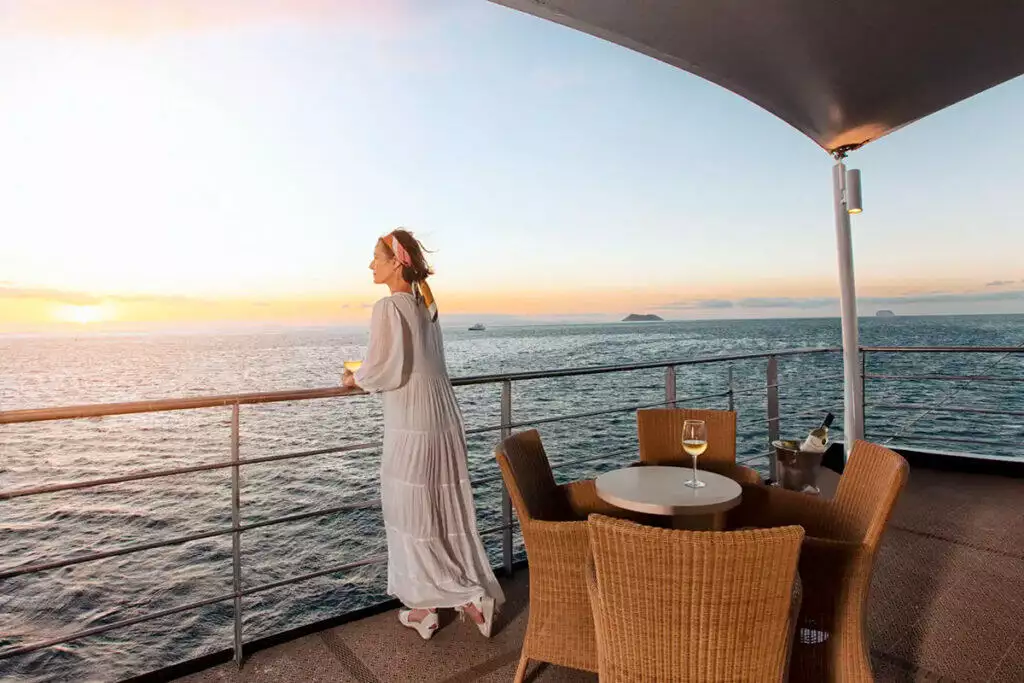
Yes, and the shape of the trip is most of the reason. You spend your nights on a guided vessel or in a small port town, not solo-navigating a large city. The crew runs a life-vest drill on day one. The guide counts heads on and off every panga. Organized Galapagos travel sits at the low-crime end of anywhere you might go, and being 60-plus doesn't change that math.
The levers that actually matter at this age are practical, not dramatic. Footing on landings, covered above. Sun and water, because the equatorial light is stronger than it feels over a sea breeze, so a hat and a filled bottle earn their place. Motion, which is gentler on the calmer eastern routes and can be firmer crossing open channels in the west. And your own medications, packed in your carry-on with a simple written note of what you take and why.
On medical support, be careful with anything you read that promises a doctor or a clinic on every ship. That provision differs from vessel to vessel, and we won't state a fleet-wide standard that isn't real. What is consistent across the boats we book is that naturalist guides and crew are trained in first aid and are equipped to respond to a basic emergency while they coordinate further help. Anything beyond that, a doctor or a clinic aboard, is a per-vessel question we check for your sailing. If you travel with a condition that needs equipment or routine treatment, tell us early: passengers regularly bring their own CPAP machines and use the cabin outlets without trouble, while something like dialysis has to be assessed with the specific vessel before we can say whether it works at all. For gender-specific safety, our solo female travel advice for Ecuador and Galapagos is the deeper read; the general solo logistics live on our traveling solo in the Galapagos guide.
"Solo travellers over sixty tend to arrive worried about crime, and that is not the thing that actually matters out here. The islands are small, guided, and about as straightforward as travel gets. What matters is the practical side: telling us about a condition before you book, bringing your own medication rather than expecting to buy it on the islands, and being straight with us about how much walking is comfortable so we put you on the right route."
— Evelyn Duran, Co-Owner
This is the worry underneath the fitness one, and it's the easiest to answer. A small yacht carries 14 to 16 guests. You share every meal, every panga, every trail with the same handful of people, and the guide introduces the group on the first evening. By the second day you know who takes their coffee early on deck and who's the keen photographer. By day four it's a group, not a boatload of strangers.
Company here is a design feature of the small boat, not a matter of luck. Sixteen people, one dining room, one guide running every briefing, one lounge for the after-dinner talk about what everyone saw. That density is exactly what makes solo travel work on a yacht, and it's exactly what a large ship can't reproduce, where a big dining room lets you finish the week having barely met anyone. If connection is what you're after, the small boat is the one to choose. Our solo Galapagos on a small yacht guide covers that social size in more detail.
And the flip side holds too. Want a quiet evening? Your cabin is private and the schedule has downtime, so you can step back when you feel like it and rejoin at breakfast. Company is on offer every day. It's never compulsory.
Most solo travelers over 60 do book a cruise, and it's still our first recommendation for most of them. Everything is guided and scheduled, the wildlife comes to you, and the company is built in. But a cruise isn't automatically the right call, and a land-based trip is a genuine option rather than a fallback.
A land-based program means sleeping in one hotel and taking day boats out to the islands. You wake in the same bed every morning, with no overnight motion and no daily repacking. You set your own tempo, and you can opt into a day trip or opt out of one. For a solo traveler who wants tighter control over their energy, that's a real strength.
"Cruises are still my first recommendation for most travelers, but there are cases where a land-based trip is the better choice. Families with very young children who want more flexible timing, for instance, or travelers with reduced mobility who'd rather skip the daily climb into a panga. A hotel-based program lets you set the pace of the trip, with more room to rest or reshape the day's activities around what each group actually needs."
— Marcelo Guerrero, Co-Owner
One thing we'd add for anyone flying in from far away: build in a mainland day. A night in Quito to catch your breath at altitude and shake off the flights before the islands isn't filler, it's part of a well-paced trip. Ecuador and the Galapagos belong in the same plan. For the full head-to-head on both styles, see our solo cruise versus land-based Galapagos comparison, and browse the two options directly: Galapagos cruises and tours or cruise and land-based packages.
The single supplement is the surcharge for having a double cabin to yourself. It exists because a cabin priced for two people still costs the operator the same whether one or two sleep in it. There are three ways around it.
On the numbers, we quote in bands and starting-from figures rather than a fixed price, because rates move through the year. What doesn't move are the fixed government costs, which are the same for everyone: the $200 Galapagos National Park entry fee (non-resident, age 12 and up) and the $20 INGALA transit control card. On the supplement, the cabins that carry none are a small, stable set rather than a rotating list: Solaris holds three, Monserrat one, and Alya one at a reduced rate, and they sit in the inventory all year rather than appearing as a seasonal offer. We confirm which of them is genuinely open to a solo traveller on your dates before quoting.
Talk with an expert insider. Tell us your dates and how much company you want, and we'll match you to the right solo sailing within 24 hours.
USA & Canada 1-773-280-9571 · Ecuador +593-987-004-404 · [email protected]
It's one of the better solo trips at this age. The day is fully guided, so you're never navigating alone, and a small yacht of 14 to 16 guests turns the group into your company for the week. The real demands are footing on landings and a sensible energy budget, both of which a small group and an attentive guide manage well.
Yes. You spend your time on a guided vessel or in a small port town rather than solo-navigating a big city, and the crew tracks every guest on every outing. Organized Galapagos travel is very low-crime. The practical safety levers at this age are footing, sun and hydration, motion on open crossings, and keeping your medications and a short medical note in your carry-on.
Almost certainly, if you choose a small boat. With 14 to 16 guests sharing every meal, panga, and trail, and a guide who introduces everyone on the first night, the group knows each other by the second day. A large ship makes that harder. If company matters to you, the small yacht is the choice.
Less than most people fear. A day is usually two guided outings of about 1.5 to 2 hours each, with meals and rest between them, and you can skip any single outing without missing the week. The effort is short walks over uneven volcanic ground and stepping in and out of a panga, not long distances. Snorkeling is optional.
Most pick a cruise, and it suits most: everything guided, scheduled, and social. A land-based trip is the better fit if you want to sleep in one bed each night, avoid overnight motion, and set your own tempo with day trips you opt into. Neither is a compromise. Our cruise versus land-based comparison lays out the trade-offs.
Usually, yes, because a double cabin costs the same whether one or two people use it. You can avoid it three ways: a no-single-supplement departure, a same-gender cabin-share match, or a vessel that prices solo cabins without the full surcharge. Waiver windows shift by month and vessel, so ask us for your dates.
The best fit is a small yacht of 14 to 16 guests, on a route matched to your tolerance for motion, with a main-deck cabin if stairs are a concern. The specific vessel depends on your dates, your budget band, and which no-supplement cabins are open. Rather than publish a "senior-friendly" shortlist that would go stale, we match the ship to how you want the week to feel, then confirm the cabin location and deck before you book.
None of the vessels we book has an elevator, and on some smaller yachts the cabins sit a short flight below the main deck. Every vessel we work with does offer main-deck cabins, which cut the stairs between decks to a minimum. If that matters to you, tell us at inquiry and we'll filter for a main-deck cabin from the start.
Live availability and starting prices for our Galapagos departures. Dates and rates update automatically.
We're an Ecuador-based team, and we book solo travelers over 60 onto these boats every week. Tell us your rough dates, how much company you're after, and whether stairs or motion are on your mind. We'll come back within 24 hours with a sailing that fits, the single-supplement status for your week, and a mainland day to land into first.
Talk with an expert insider.
USA & Canada 1-773-280-9571 · Ecuador +593-987-004-404 · [email protected]



