
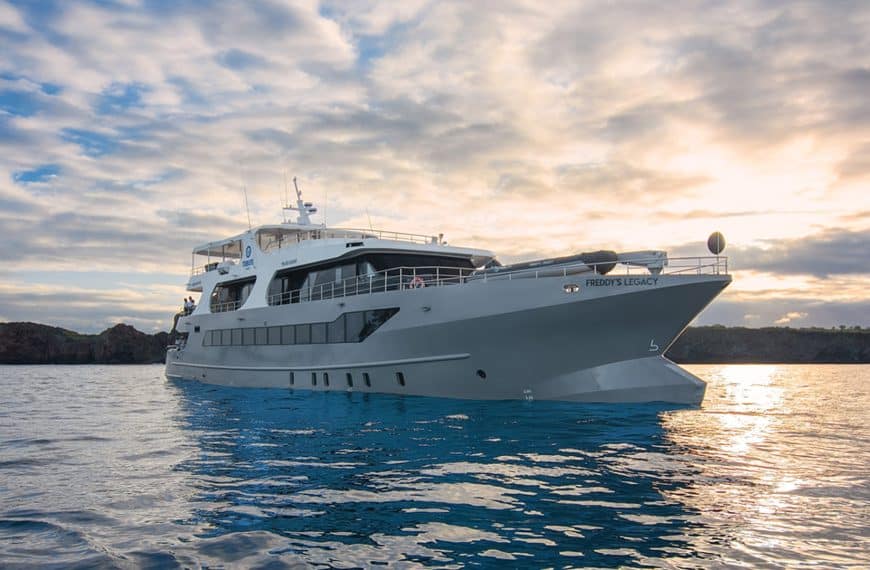
Written by Marcelo Guerrero Oquendo, Co-Owner of Galapagos Insiders since 2015. Last updated May 2026.
A small Galapagos yacht in 2026 carries 16 guests at most and runs the standard 1:16 single-guide configuration. That ratio — not the cabin, not the cuisine — is the single thing your dollar is buying. We book seven of these yachts. We've sailed every one.
Talk with an expert insider — we'll match you to the right small yacht in 24 hours.
USA & Canada 1-773-280-9571 · Ecuador +593-987-004-404 · [email protected]
A small Galapagos yacht is a vessel that carries 16 passengers or fewer, sails with at least one naturalist guide, and hits the legal 1-guide-per-16-guests landing cap by design. The default on a 16-pax yacht is one guide with the whole group landing together; a few operators (Endemic and Elite charter upgrades, Infinity when its capacity drops to 10) carry a second guide and split landings into smaller groups of about eight — that is a paid operator upgrade, not a fleet-wide standard. We book seven small yachts for 2026 — Galapagos Sea Star, Natural Paradise, Infinity, Endemic, Elite, Galaxy Sirius, and Alya — across the luxury and premium catamaran tiers. Every one of them is 16-pax or smaller. The single thing that distinguishes a small yacht from a 90- or 100-passenger small ship isn't size for size's sake — it's the ratio. At 16 guests, you're not in a queue at any landing. You're with the guide who has time to slow down and find the wildlife other groups walk past.
The phrase "small ship" gets used loosely. We do not.
| Aspect | Small yacht (this page) | Small ship (sibling page) |
|---|---|---|
| Capacity | ≤16 guests | 50–100 guests |
| Guide ratio at landings | 1:16 ratio (automatic) | 1:16 (group split) |
| Pangas at landings | 2 pangas, group of 8 each | 4–6 pangas, group of 16 each |
| Onboard amenities | Library, sundeck, plunge pool on some hulls | Lecture room, gym, multiple lounges, library |
| Stability in heavy swell | Catamaran hulls = stable; monohull = more roll | Highest stability of any class |
| Social mix | 8–16 people for a week | 50–100 people, more variety |
| Best for | Wildlife density per landing, intimacy, photographers | Stability-first travelers, lecturers, mobility issues |
The real difference. Small ships (La Pinta, Santa Cruz II, Isabela II) are excellent vessels — we don't book them, but we recommend them when stability and onboard amenity depth matter more than landing-group size. What small ships cannot offer is a 1:16 ratio with one guide at the landings, because the The Galapagos National Park assigns one naturalist per 16 guests. On a 100-pax small ship, you're a group of 16 with one guide. On a 16-pax small yacht, you're a group of 8 with one guide. That is the trade. For the small-ship comparison, see our Galapagos small-ship cruises page.
This is the part of the small-yacht argument that no operator brochure explains well. We will.
"We've seen firsthand how the two-guide upgrade changes the entire wildlife experience. In July 2025, on a western itinerary aboard the Galaxy Sirius, our guide had the time to slow the group down at Punta Espinosa on Fernandina and quietly scan the lava fields. Because we weren't rushed or spread thin, he spotted a well-camouflaged Galapagos hawk perched low — something two larger groups ahead of us (closer to 1:16) had completely walked past. We ended up spending nearly 10 minutes observing its behavior and even saw it take off. That kind of moment only happens when the guide has the bandwidth to truly guide, not just manage a crowd."
— Marcelo Guerrero, Co-Owner, Galapagos Insiders
That's the trade in plain language. On a 100-pax small ship or a 32-pax catamaran, the park-mandated split puts you in a group of 16 per naturalist. The wildlife is the same on both routes — Punta Espinosa is Punta Espinosa whether you arrive on a 32-pax catamaran or a 16-pax small yacht. What changes is whether the guide has time to scan the lava fields slowly, point quietly, and let the group settle into a 10-minute observation. On 1:16, you're keeping pace with the front of the group. On 1:16 ratio, the guide stops when something is worth stopping for. Across two seasons of trip reports, the moments our travelers describe to their friends afterward almost all came off small yachts. That isn't snobbery — it's the pattern.
It's also why we don't recommend a small yacht just because it's small. If your priority is stability in August Western swell and you don't mind a 1:16 landing group, a small ship is the better hull. If your priority is the wildlife window per landing, a small yacht wins every time.

Most operator pages call their guides "expert" and call it a credential. We name ours.
"Andrés, the senior naturalist guide aboard the Infinity Yacht, is widely known among repeat Galápagos travelers for his uncanny ability to anticipate wildlife behavior — he's the one who slows a group down just enough to witness moments others miss, like blue-footed boobies beginning their courtship dance or marine iguanas synchronizing their feeding cycles with the tides."
— Marcelo Guerrero, Co-Owner
Andrés is a senior naturalist guide with 5 years on the Infinity Yacht specifically — most small-yacht naturalists are freelance and rotate across operators week to week. Tenure on a single boat is itself a small-yacht detail, because at 16 passengers there's enough continuity for a guide to actually know the captain's site-sequencing habits and the panga-driver's tide reads. He calibrates the day around the wildlife window the boat is in. Andrés is one example. The seven yachts in our 2026 small-yacht inventory each have one or two of these naturalists. We can tell you who's expected on the boat the week of your departure when we're booking — operators don't promise specific guides, but our reservations team tracks who's typically rotating where. (Permission to use Andrés's name confirmed.)
Reasons to book a small yacht
Cons worth flagging

Our 2026 small-yacht priority list. Each card lists capacity, guide ratio, what stands out, and the snorkel-program data where we have it. All are 16-pax or smaller.
For the broader vessel menu, see our Galapagos cruises hub, the 16-passenger yachts sibling page, the luxury Galapagos cruises cross-page, and the small-ships cousin page for the 50–100-pax tier.
Both hull types come in 16-pax. The choice is about itinerary and sea-state, not cabin count.
| Hull | Vessels in our 2026 list | Stability | Best for |
|---|---|---|---|
| Catamaran (twin hull) | Endemic, Elite, Galaxy Sirius, Alya | High — significantly less roll in the Bolívar Channel | Western itineraries, August–September swell, travelers prone to seasickness |
| Motor yacht (single hull) | Sea Star, Natural Paradise, Infinity | Moderate — more traditional yacht profile, slightly more roll on Western | Eastern itineraries year-round, travelers who prefer the classic-yacht aesthetic |
If route choice is unresolved when you reach this page, our Galapagos cruise itineraries comparison walks the Eastern / Western / Northern / full-archipelago decision in route-specialist detail. For Western in August or September on a small yacht, we bias hard toward the catamarans on the list.

Most of our 2026 small yachts run the standard 8-day Eastern or Western backbone on alternating park-assigned weeks. A few — Endemic, Natural Paradise — run back-to-back combined Eastern + Western for 11-, 14-, or 15-day full-archipelago trips, which is the right call for photographers and retirees who want the species inventory in one visit. The Galaxy Sirius runs Western on the the park-assigned weeks the centerpiece field-note came from. Sea Star skews Eastern. Infinity runs Western with strong honeymoon demand.
5- and 6-day "short-cruise" patterns also exist on most of these hulls — useful when a domestic-flight constraint or a tight schedule forces a sub-8-day window. The short cruises sample either the Eastern or Western core but skip the Floreana or Fernandina day. We default-recommend the full 8-day on a small yacht if your dates allow.
Working numbers, rounded, per person on shared occupancy. Always confirmed against live availability before quote. Small yachts span the premium catamaran and luxury tiers — they are not a budget option, because the 16-pax economics carry the per-guest cost up.
| Length | Low season (Jan–Apr, Sep) | Shoulder (May, Nov) | Peak (Jun–Aug, Dec) |
|---|---|---|---|
| 5-day | — | — | — |
| 6-day | — | — | — |
| 8-day | — | — | — |
| 11-day combined | — | — | — |
| 15-day full-archipelago | — | — | — |
Add to every cruise quote: domestic flights Quito/Guayaquil → Baltra/SCY ($250–600 round trip), Galapagos National Park entry fee ($200, non-resident age 12+), INGALA Transit Control Card ($20), tips ($200–400 per person typical), pre/post Quito stay ($150–600). Full math in our Galapagos cruise cost 2026 guide. Prices are 2026 USD from-rates, per person, double occupancy, before park fees and flights.
| Vessel class | Typical capacity | 8-day per-person price band | Best for |
|---|---|---|---|
| Small yacht (this page) | ≤16 | $5,000–$11,000+ luxury band | the 1:16 ratio ratio, intimacy, photographers, honeymoon |
| Mid-range catamaran | 16–32 | $3,500–$5,300 mid-range | First-timers, families, value |
| Small ship | 50–100 | $7,000–$10,000+ luxury | Stability, lectures, mobility |
| Motorsailer | ≤16 | $3,900–$4,900 budget motor yacht | Romance, authenticity, value at small size |
| Dive liveaboard | ≤16 | $7,000–$7,400 dive-specialist | Certified divers chasing Darwin/Wolf |
Each row links to the sibling vessel-class page when those go live: catamaran, 16-passenger yacht, small ship, private charter, motorsailer.
Roughly 90% of the small-yacht fleet runs Starlink in 2026 (data pack Q-F1). On the seven yachts in our 2026 priority list, expect working Wi-Fi for email, light video, and weather checks. Streaming a movie at 4K is still optimistic — open-ocean transit between Isabela and Fernandina drops bandwidth.
Onboard medical staff and elevators vary by vessel — we'll confirm exactly what each ship offers before you book. What no small Galapagos yacht offers is a guarantee of a specific named guide: naturalists are freelance and operator-rotated.
"Our six-day stay aboard the Galapagos Sea Star yacht was truly the highlight of the trip. The crew members were exceptional — warm, attentive, and genuinely passionate about making our experience unforgettable. Our naturalist was extremely knowledgeable. Every excursion felt special, and her enthusiasm made a lasting impression on all of us."
Karen C. from New York City (Tripadvisor Review) — Galapagos Sea Star, March 2026
"It was a dream working with Galapagos Insiders. We had a lovely trip on the Bonita Yacht and they helped coordinate all the necessary details before the trip. They were super responsive and helpful!"
Christream from Charlottesville, Virginia (Tripadvisor Review) — Bonita, June 2025
Aggregate rating across our review sources: 4.9 / 5 across 350 verified reviews (2021–2026) — TripAdvisor, Trustpilot, Google Business Profile, WeTravel.
The small yachts we book most often for honeymoons in 2026 are Natural Paradise, Galapagos Sea Star, and Galapagos Tribute — all three have cabin layouts designed around couples (rather than family connecting cabins), and Aqua Mare adds superyacht-grade privacy if the budget allows. For honeymooners who specifically want twin-hull stability — a common request from couples worried about seasickness — the catamarans Endemic, Alya, and Ocean Spray are the equivalent picks on our catamarans page. For the deeper read on honeymoon vessel selection, see our Galapagos honeymoon cruises page.
A small yacht typically holds 4 to 8 cabins your family group can fully book — which means a multi-generational party of 12 to 16 can effectively charter the boat as a family. Monserrat and Grand Majestic are the two motor yachts we charter most for this scenario; both have the cabin distribution (a mix of doubles, twins, and a triple or two) that handles three generations cleanly. Minimum age policy is typically 6+; some operators allow 8+ on Western itineraries because of the Bolívar swell. Confirm at booking. For the full-boat charter conversation, see our private charter page.
Single-supplement waivers on small yachts are rare but real. The motor yachts in our small-yacht 2026 inventory that occasionally extend no-single-supplement windows in shoulder months are Solaris, Bonita, and Monserrat, plus the budget-tier Cachalote Explorer which runs no-single-supplement on shoulder months. If you're a solo traveler, ask us to flag the next no-single-supplement window — we track them by week. The catamarans Alya, Galaxy Sirius, and Hermes have similar windows on the catamarans page. Deeper read: our solo Galapagos cruise page.

A small Galapagos yacht is a vessel that carries 16 passengers or fewer. By park rule each landing must run at the 1:16 cap; the default is one naturalist guide for the full 16 guests, and a two-guide upgrade is an occasional operator option offered on a subset of vessels (e.g., Infinity at reduced 10-pax capacity, plus catamaran-charter upgrades on Endemic and Elite — see our catamarans page for those). The seven small yachts we prioritize for 2026 are Galapagos Sea Star, Natural Paradise, Infinity, Endemic, Elite, Galaxy Sirius, and Alya.
The Galapagos National Park caps walking groups at 16 per naturalist on every visitor-site landing. A 16-pax yacht with two naturalists splits 8/8 at landings — the 1:16 ratio every operator markets as "luxury" comes standard. Smaller boats (8–14 guests) usually charge more per person to cover a full naturalist's salary on a smaller revenue base. Larger boats (32+ guests) have to land as multiple groups of 16, which staggers the day and sometimes pushes the third group past the prime wildlife window. That math is why almost every premium and luxury small yacht in the Galapagos is built to exactly 16 capacity.
Capacity and ratio. A small yacht carries ≤16 guests and runs a 1:16 ratio with one guide at landings. A small ship (La Pinta, Santa Cruz II, Isabela II) carries 50–100 guests and runs a 1:16 ratio at landings. The wildlife is the same on both; the landing-group experience is not. We book small yachts only — we point travelers to small-ship operators when stability or onboard amenity depth matters more than the landing ratio.
By default, one naturalist guide leads all 16 guests at every landing — that is the legal 1:16 cap the the Galapagos National Park has enforced since 1975. A subset of operators run a two-guide upgrade (Infinity when its capacity drops to 10, plus catamaran-charter upgrades on Endemic, Elite, and Galaxy Sirius — see our catamarans page); on those departures the group splits into smaller landings of about eight per guide. Ask us before booking whether your specific departure carries one guide or two — it varies by operator and by sailing.
8-day small-yacht cruises start from USD luxury-tier entry pricing per person, double occupancy (Natural Paradise with promotional pricing applied), with regular small-yacht 8-day rates running $6,300–$11,000+ and peak-season weeks 30 to 45% above shoulder months. Add domestic flights ($250–600), park fee ($200), INGALA card ($20), tips ($200–400), and pre/post Quito ($150–600). Full breakdown in our cost guide.
Yes — specifically Sea Star and Infinity, the two small yachts we book most for multi-generational groups (Q-F7). Both have cabin layouts that handle three generations on the same hull. Minimum age policy on most small yachts is 6+; some operators allow 8+ on Western itineraries because of the Bolívar swell. Confirm at booking. For the broader family read, see our first-time Galapagos cruise page.
Catamaran for Western itineraries in August and September, where Bolívar Channel swell rewards twin-hull stability. Monohull (single-hull motor yacht) for Eastern itineraries year-round, where seas are calmer and the classic-yacht aesthetic matters more than swell management. All vessels on our small-yacht 2026 list are motor yachts (monohulls): Sea Star, Natural Paradise, Infinity, Grand Majestic, Tribute, Aqua Mare, Galaxy Orion, plus mid-range Solaris, Bonita, Calipso, Beluga, Monserrat, Galapagos Angel, Grand Queen Beatriz, and budget Cachalote + Aqua. For catamarans (twin-hull stability) see our catamarans page.
Rarely. Most operators charge 1.5x to 2x for solo bookings on small-yacht cabins. The vessels in our 2026 inventory that occasionally extend no-single-supplement windows in shoulder months are Solaris, Bonita, Monserrat, Cachalote Explorer (motor yachts) and Alya, Galaxy Sirius, Hermes (catamarans — see catamarans page). Alya and Galaxy Sirius are the small-yacht-list overlaps. We track these windows by week — ask us at inquiry stage. Deeper read: our solo Galapagos cruise page.
30% deposit at booking holds the cabin. Balance due 60 days before sailing. There is no free-cancellation window once a deposit is confirmed — booking conditions apply. The same policy applies across operators in our small-yacht inventory.
Our answer: only if the the 1:16 ratio ratio and the 16-pax intimacy match how you want to travel. A 32-pax mid-range catamaran sees the same wildlife and runs the same routes. What you don't get on the 32-pax is the landing-group of 8, the crew-knows-your-name continuity by Day 3, and the catamaran-tier stability without scaling up to a 100-pax small ship. If those three things matter to you, the small yacht pays out. If they don't, the mid-range is the smarter dollar.
Tell us your dates, length, and route preference. We send a 24-hour proposal with live availability across our 2026 small-yacht list. 30% deposit holds the cabin; balance due 60 days out. USA & Canada 1-773-280-9571 · Ecuador +593-987-004-404 · [email protected].
24-hour quote. No-pressure proposal. We'll match you to a yacht, route, and date based on traveler profile, dates, and which of the seven small yachts has the right week open.
USA & Canada 1-773-280-9571 · Ecuador +593-987-004-404 · [email protected]
Follow us on Facebook for live cabin releases and trip-report photos.



