If you are planning a Galapagos trip with your family, one of the first decisions you will face is what kind of vessel to travel on. It is also one of the most important, because the ship you choose shapes almost everything about your experience — from how close you get to wildlife to how much your children actually learn.
There are two fundamentally different ways to cruise the Galapagos, and they deliver very different family experiences. We want to help you understand both, honestly, so you can make the right choice for your family.
We should be upfront: we exclusively work with small expedition ships. That is a deliberate choice, and we will explain why. But we also want to be fair about what large ships offer, because the right answer depends on your family's priorities.
Before we compare, let us clarify what we are actually talking about, because the terminology can be confusing.
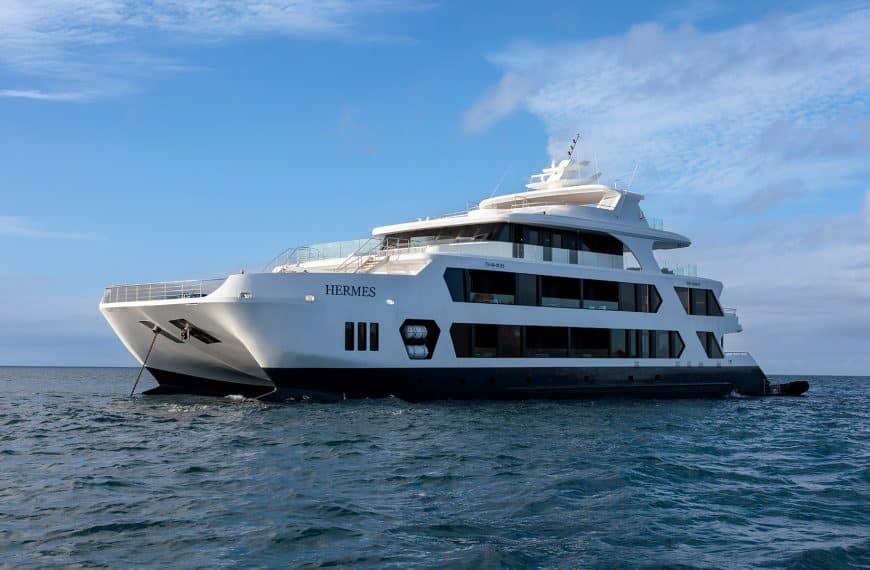
These are purpose-built or purpose-adapted vessels that operate entirely within the Galapagos archipelago. They carry between 8 and 100 passengers, follow itineraries approved by the Galapagos National Park, and have certified naturalist guides on board. Your family lives on the ship for the duration of the cruise — typically 4, 5, or 8 days — and makes two guided excursions per day to different islands and visitor sites.
This is the traditional way to explore the Galapagos and the only type of vessel we work with. For a deeper look at specific ships, see our guide to the best Galapagos boats for families.
These are ocean-going cruise liners that include the Galapagos as one stop on a broader South American or Pacific itinerary. They may spend one to three days in the archipelago, anchoring offshore and tendering passengers to a handful of the most accessible sites. They carry 500 to several thousand passengers and offer the full large-ship experience: pools, entertainment, multiple restaurants, kids' clubs, and spa facilities.
For more context on why ship size matters in the Galapagos specifically, we have written about Galapagos boats and why size matters.
The Galapagos National Park tightly regulates tourism to protect the islands' ecosystems. This is not bureaucracy for its own sake — it is the reason the wildlife is still there.
Key regulations that shape the small-ship model:
Large cruise ships cannot follow this model. They do not have assigned National Park itineraries, their passenger numbers far exceed site limits, and they cannot navigate the shallow channels between islands. Instead, they anchor at one or two accessible ports and ferry groups ashore in batches.

| Factor | Small Expedition Ship (8-100) | Large Cruise Ship (500+) |
|---|---|---|
| Islands visited | 10-15+ sites across the archipelago, including remote islands | 2-4 accessible ports (typically Santa Cruz and San Cristobal) |
| Wildlife proximity | Guided walks within 2 meters of animals on undeveloped trails | Town-based sites; wildlife present but less concentrated |
| Guide ratio | 1 guide per 8-16 passengers (your children get personal attention) | Shore excursion groups of 20-40+ with a local guide |
| Snorkeling | Daily opportunities at varied sites; guide-led, gear provided | Limited; may require booking separate excursions in port |
| Onboard amenities | Comfortable but simple: dining room, sun deck, some have jacuzzis. No pool, no kids' club, no elevator | Pools, kids' clubs, multiple restaurants, entertainment, spa, elevator access |
| Motion and seasickness | More motion, especially on open-water crossings. See our seasickness prevention guide | Significantly more stable due to size; less motion sickness risk |
| Time in Galapagos | 4-8 days entirely in the archipelago | 1-3 days as part of a longer itinerary |
| Minimum child age | Most require children to be 6+; land-based alternatives for younger kids | Varies; some accept infants |
| Medical facilities | No onboard doctor; basic first aid kit, crew trained in first response | Onboard medical center with doctor |
| Dietary needs | All ships accommodate dietary requirements with advance notice | Multiple dining venues; wide range of options |
| Environmental impact | Smaller footprint; regulated by National Park; supports conservation | Higher fuel consumption per visit; concentrated impact at port towns |
| Cost | Higher per-day cost but includes all excursions, meals, and guide. See our 2026 family cruise cost guide | Lower per-day sticker price, but Galapagos excursions often extra |
| Internet | 90% of ships now have Starlink; speeds vary | Ship-wide Wi-Fi (paid or included depending on cruise line) |
The comparison table tells the factual story, but here is what it feels like in practice for your family.
Small ships visit remote islands that large ships simply cannot reach. Fernandina, Espanola, Genovesa — these are where the most extraordinary wildlife encounters happen. Your children will walk past nesting albatrosses, snorkel with sea turtles, and watch penguins waddle across lava rock. On a large ship, the Galapagos experience is limited to what you can see from Santa Cruz and San Cristobal — wonderful places, but a fraction of what the archipelago offers. See our guide to the best islands for kids for specifics.
On a small ship, you have the same naturalist guide for the entire voyage. They learn your children's names, their interests, their questions. By day three, your guide knows that your eight-year-old is obsessed with blue-footed boobies and will point out every one. They know your teenager wants to understand plate tectonics and will explain the volcanic geology in detail.
On a large ship, you get a different local guide for each port excursion. There is no relationship, no continuity, and no personalisation. Our guide to child-friendly naturalist guides explains why this relationship matters so much for families.

When your family steps onto North Seymour to see the frigate birds, you are walking with 10-16 people, not 40. The trails feel peaceful. Your children can pause to watch a sea lion without feeling rushed. The guide can answer questions without shouting over a crowd. This intimacy is not a luxury — it is how the Galapagos is meant to be experienced.
Children on small ships make friends quickly. With only a handful of families on board, kids form bonds over shared snorkeling adventures and wildlife sightings. Mealtimes are communal. Evening briefings about the next day's excursion build anticipation together. For multigenerational families, the intimate setting means grandparents, parents, and children share every experience rather than scattering across a vast ship.
Yes. Small ships are not perfect for every family, and you should know the trade-offs.
Smaller vessels feel the sea more. Open-water crossings — particularly between the central and western islands — can be rough, especially from July to November when seas are choppier. Children (and adults) prone to motion sickness should take precautions. Our seasickness prevention guide for kids covers what works. Choosing a more stable ship also helps — catamarans and larger expedition vessels (60-100 passengers) handle swells better than smaller yachts.
There is no swimming pool. There is no kids' club. There is no evening entertainment program. There are no elevators, which matters for families with mobility considerations. If your family needs structured downtime activities or your children require constant entertainment between excursions, this is worth considering.
That said, most families tell us the opposite problem occurs: there is so much to see and do on excursions that children collapse happily into bed each evening. The lack of a pool matters much less when you have been snorkeling with sea lions all morning.
The small expedition yachts we recommend do not carry a doctor, though some larger Galapagos vessels (40+ passengers) do. Crew members are trained in first aid, ships carry medical supplies, and emergency evacuation to hospitals on Santa Cruz or San Cristobal is always available. But if your child has a medical condition that might require professional attention at short notice, this is an important factor. Our family safety guide covers medical preparedness in detail.
Most small expedition ships do not accept children under 6. This is a practical limitation — zodiac landings, trail walks, and snorkeling require a certain level of independence. If you are traveling with younger children, a land-based Galapagos trip is the better choice.

Not all small ships are the same. Within the 8-100 passenger range, there are meaningful differences for families.
The most intimate experience. Your family might be one of only two or three families on board. The guide ratio is exceptional — often 1 guide per 8-10 passengers. The downside: these are the smallest vessels, so motion is most noticeable. Cabins tend to be compact. Best for families with older children (10+) who value exclusivity and can handle some movement.
The sweet spot for most families. Enough passengers that your children will likely find other kids to bond with, but small enough to maintain intimacy and excellent guide ratios. Cabins are more spacious, and the ships are more stable than yacht-class vessels. This is the range where we find the widest selection of mid-range family expedition options.
The most stable ride and the most spacious cabins. Some ships in this range have jacuzzis, dedicated briefing rooms, and more generous common areas. The trade-off is that landing groups are larger (though still split into sub-groups of 16 with separate guides). These ships suit families who want a small-ship experience with a bit more comfort, and they are often the best choice for multigenerational groups where grandparents value stability and space. See our luxury family cruise options for the best in this category.
We would not be honest if we said a large ship is never the right choice. It might be, if:
But if the Galapagos is the destination — if your goal is for your children to experience these islands deeply, to learn about evolution and conservation, to snorkel with sea turtles and walk among nesting birds — then a small expedition ship is how you do that. It is not even close.
Not sure which ship is right for your family?
Tell us your children's ages, your travel dates, and what matters most to you. We will recommend specific ships from our fleet that match your family's needs — no pressure, no obligation, just honest advice from people who know every vessel personally.