

Written by Marcelo Guerrero Oquendo, Co-Owner of Galapagos Insiders since 2015. Last updated May 2026.
A "Galapagos safari" is a wildlife-focused expedition cruise. By African terminology, every Galapagos cruise IS a wildlife safari — there is no other way to see the archipelago's species at scale. Here's what that actually means, where to go, and which boat to be on in 2026.
Talk with an expert insider — we'll match you to the right safari cruise in 24 hours.
USA & Canada 1-773-280-9571 · Ecuador +593-987-004-404 · [email protected]
A Galapagos safari is a Galapagos cruise built around wildlife observation. The word "safari" in this context is not the African game-drive model — there are no jeeps, no Land Rovers, and no big-five checklist. It's a sea-based expedition that uses a small vessel as your moving lodge and pangas (10-passenger zodiac inflatables) as your wildlife transport. Your "game drives" are GNPD-licensed naturalist-guided walks on protected visitor sites and panga snorkels at marine sites. Two visitor sites a day, every day, across a 4-day, 8-day, or 15-day route. The wildlife is endemic, dense, and extraordinarily fearless of humans — which is exactly what makes the Galapagos the closest thing to an African safari that exists outside Africa, and in some respects denser per square kilometre.
Most safari-priority travelers do an 8-day Western or Eastern itinerary on a luxury catamaran or yacht (16 guests) with a two-guide upgrade. We book Galapagos safari cruises across our portfolio of 38 GNPD-licensed vessels for 2026. 8-day from-rates land in three bands: mid-range (Galaxy Orion promotional pricing), first-class (Tip Top II promotional pricing), and luxury (Natural Paradise promotional pricing). Regular luxury 8-day pricing runs $6,000–$11,000+. The land-safari analogue (a Santa Cruz hotel + day tours) exists, but the marquee wildlife sites are GNPD-allocated to liveaboard cruise itineraries — that's the part that determines what you actually see.
Every percentage and frequency below is sourced from our own naturalist-guide logs across 2024–2026. Not from generic operator marketing.
Six things make the Galapagos cruise the sea-going equivalent of an African safari, and one thing makes it materially different.
The one material difference: density per square kilometre is higher in the Galapagos than in any African game park we know of. You don't drive for hours hoping to find wildlife; you walk 200 metres from the panga landing and you're standing two metres from a nesting blue-footed booby. I describe this from a recent western sailing in his own words further down — see "First-hand wildlife observations" below.
| Dimension | "Land safari" (hotel + day tours) | "Sea safari" (cruise) |
|---|---|---|
| Base | Santa Cruz, Isabela, or San Cristóbal hotel | Liveaboard 16-guest yacht or catamaran |
| Daily wildlife sites | 1 site/day, often shared with multiple groups | 2 sites/day (AM + PM), single-vessel allocation |
| Marquee sites accessible | Pinzón, Las Tintoreras, Los Túneles, Kicker Rock day tour | Devil's Crown, Punta Vicente Roca, Fernandina (Punta Espinosa), Genovesa, Española (Punta Suárez), Bartolomé, Champion Islet |
| Panga / zodiac time | Minimal (transfers only) | Daily (wet/dry landings + panga rides) |
| Guide ratio | the 1:16 ratio to 1:16 depending on day-tour operator | 1:16 standard; the 1:16 ratio on luxury vessels |
| Trip length | Flexible (3–10+ days possible) | Fixed (4-day, 5-day, 6-day, 8-day, 11-day, 15-day) |
| Best for | Mobility-constrained, motion-sick, families with under-6 kids, sub-5-day budgets | Wildlife-priority travelers, photographers, repeat naturalists |
If wildlife is the reason you're going, the sea safari is the answer for most travelers. The land-safari path is real and worth the trip for the right traveler — see Galapagos land-based tours 2026 — but it doesn't reach Fernandina, Genovesa, Española's Punta Suárez, or Punta Vicente Roca. Those are cruise-only, and they are precisely the sites that justify the "safari" framing.

We've guided every site on this list across 2024–2026. The archipelago has more than 70 GNPD-approved visitor sites. Eight carry the safari reputation. Each one is governed by daily-visitor caps and licensed-guide rules.
Sighting frequencies above are based on what our GNPD-licensed naturalist guides and the boat operators we work with have logged across multiple seasons of sailings since January 2024. Wildlife is wildlife — we don't guarantee any single species, and any guide who does is selling you a story.
The Galapagos isn't one route — it's three. Each one is a different wildlife "concession" with different marquee species. We cover route choice in depth on the Galapagos itineraries 2026 page; here's the safari-relevant summary.
On Western for serious-wildlife travelers, my view (verbatim, August 2025 Infinity sailing):
"For honeymooners or couples who really want that 'once-in-a-lifetime' wildlife intensity, we almost always recommend the western route — specifically itineraries that include Fernandina Island and the Bolivar Channel along Isabela Island. Yes, there can be more swell, especially between July and November, but the payoff is unmatched. In August 2025, we had a couple on the Infinity Yacht who snorkeled with over 40 green sea turtles in a single outing and watched flightless cormorants hunting just meters away. They told us afterward they hadn't realized how different the western ecosystem feels — raw, remote, and incredibly active. For travelers who can handle a bit of movement, it's absolutely worth it."
— Marcelo Guerrero, Co-Owner

A vessel is "good for safari" when four things line up. A two-guide upgrade, not the 1:16 standard. In-water naturalist during the snorkels. High GNPD-licensed-guide tenure (years on the same vessel = cumulative knowledge of which lava ledge the hawk hunts from). And two wildlife outings per day plus a snorkel, not the cut-down "one wildlife outing + free time" pattern that some boats run on rest days.
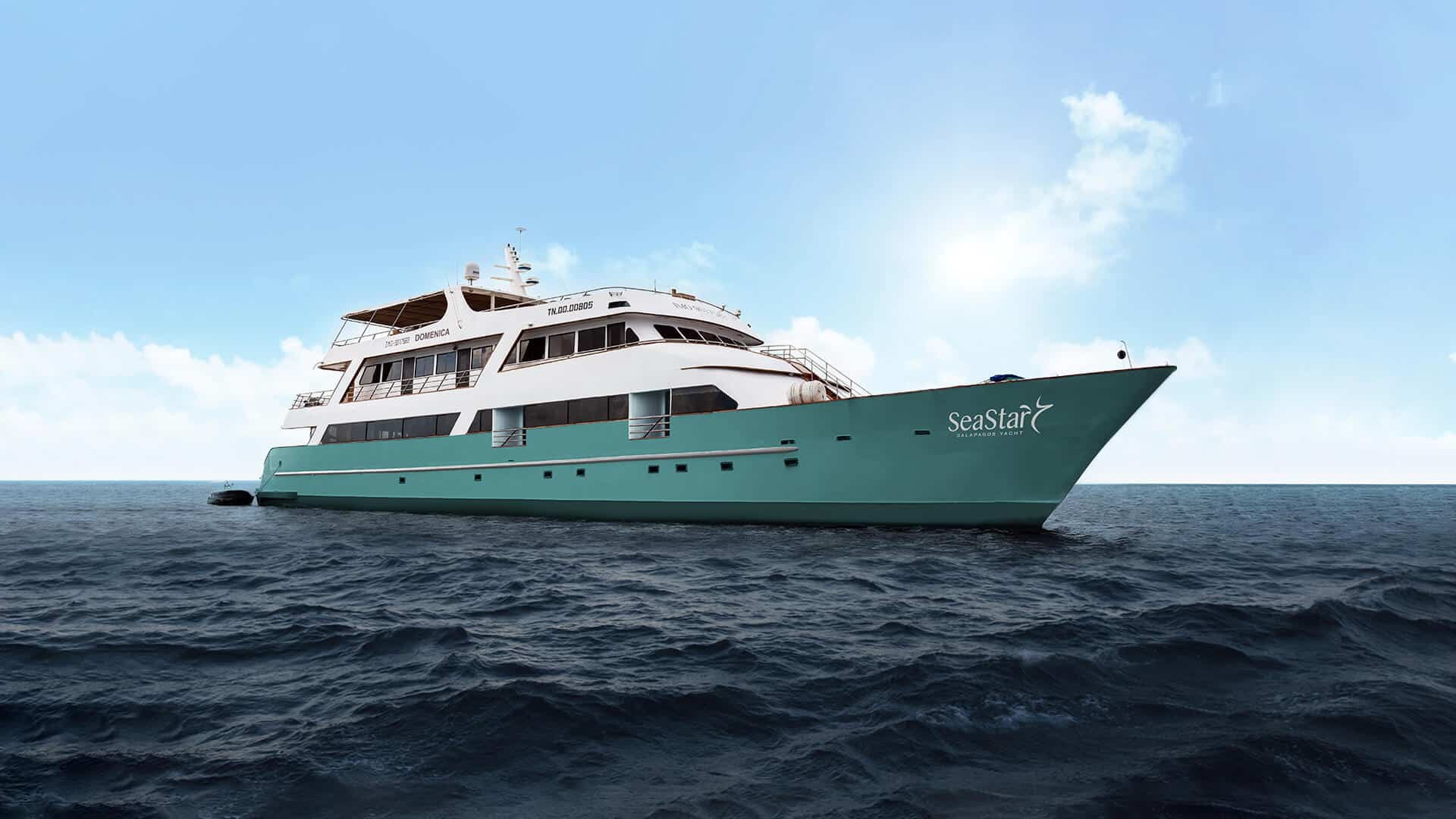
For 2026, We confirmed seven vessels GI prioritizes for luxury wildlife trips: Galapagos Sea Star, Natural Paradise, Infinity, Endemic, Elite, Galaxy Sirius, and Alya (Q-E3, verbatim). The cards below cover the safari-relevant ones from that list. We've not duplicated the snorkel-program detail that lives on the snorkeling cruises page — for sessions/day, wetsuit thickness, and dry-camera storage, see that page.
Live next-departure feeds for the seven vessels above:
Browse all 2026 luxury 8-day departures — most include strong wildlife programs:
Mid-range catamarans on the GI roster also deliver high-density wildlife — the visitor sites are GNPD-allocated, not vessel-allocated, so the wildlife is the same on a mid-range vessel as on a luxury one. The luxury upgrade buys you the 1 National Park licensed guide at 1:16 ratio and the small things that compound across an 8-day trip: the guide who has time to slow the group down, the unhurried scan of the lava field, the 10 minutes spent observing a Galapagos hawk that the 1:16 group walked past. If your budget is mid-range and wildlife is the priority, talk with us — we'll match you to the right mid-range vessel that runs two outings a day with the strongest naturalists.
Cruise length is the single biggest decision after route. The comparison:
| Length | Sites visited | Marquee species reachable | Best for | Cost band |
|---|---|---|---|---|
| 4-day / 5-day | 6–8 visitor sites | Subset of one route only — typically central-archipelago beginners (North Seymour, Bartolomé, Santa Fe) | Travelers with a hard time budget; first taste of the islands | Lowest |
| 6-day / 7-day | 10–12 visitor sites | One full route (Eastern OR Western OR Northern), most marquee sites | Most travelers — best balance of depth and budget | Mid |
| 8-day | 14–16 visitor sites | One full route at depth — Western sailings cover Fernandina + Punta Vicente Roca; Eastern sailings cover Española + Kicker Rock + Floreana | The standard safari length; recommended baseline | Mid–high |
| 11-day / 15-day | 22–28 visitor sites | Two routes combined (Eastern + Western, or Eastern + Northern) | Repeat naturalists; serious wildlife photographers; travelers who want both the western marine-iguana density AND the Española albatross | Highest |
On the most-common misconception about 8-day cruises (verbatim, Q-B4):
"The most common misconception we correct about 8-day cruises is that they 'cover everything.' Travelers often come to us thinking one week is enough to fully experience both the western highlights like Fernandina Island and the more central or southern sites like Floreana Island. The reality is, no single 8-day itinerary does it all without trade-offs. In 2025, we worked with a couple who chose a 'combined' route, only to realize afterward they missed key sites like Punta Espinosa. Now we're very upfront — if you want both regions done properly, you're looking at back-to-back cruises or at least 11–15 days. Eight days is amazing, but it's curated, not comprehensive."
— Marcelo Guerrero, Co-Owner
For the per-length depth breakdown, see 5-day cruises, 6-day, 7-day, and extended (10+ day).
These are the moments that explain why the Galapagos cruise functions as a safari — not by analogy, but by what actually happens on the trail and in the water.
"We've seen firsthand how the two-guide upgrade changes the entire wildlife experience. In July 2025, on a western itinerary aboard the Galaxy Sirius, our guide had the time to slow the group down at Punta Espinosa on Fernandina Island and quietly scan the lava fields. Because we weren't rushed or spread thin, he spotted a well-camouflaged Galapagos hawk perched low — something two larger groups ahead of us (closer to 1:16) had completely walked past. We ended up spending nearly 10 minutes observing its behavior and even saw it take off. That kind of moment only happens when the guide has the bandwidth to truly guide, not just manage a crowd."
— Marcelo Guerrero, Co-Owner
The practical implication for safari travelers: ask your booking agent the guide-to-guest ratio before you commit. the 1:16 ratio is the safari-grade number; 1:16 is the standard. The same wildlife is on the same lava field — the difference is whether anyone in your group sees it.
"For honeymooners or couples who really want that 'once-in-a-lifetime' wildlife intensity, we almost always recommend the western route — specifically itineraries that include Fernandina Island and the Bolivar Channel along Isabela Island. Yes, there can be more swell, especially between July and November, but the payoff is unmatched. In August 2025, we had a couple on the Infinity Yacht who snorkeled with over 40 green sea turtles in a single outing and watched flightless cormorants hunting just meters away. They told us afterward they hadn't realized how different the western ecosystem feels — raw, remote, and incredibly active. For travelers who can handle a bit of movement, it's absolutely worth it."
— Marcelo Guerrero, Co-Owner
The practical implication: if you can handle modest swell and you're choosing between Eastern and Western for a wildlife-priority safari, choose Western. If swell is a deal-breaker, choose Eastern and accept that you'll trade the marine iguanas of Fernandina for the albatross of Española — both extraordinary, neither replaceable by the other.
For the snorkel-side companion to the safari — schools of scalloped hammerhead sharks at Kicker Rock on 9 of 11 early-morning sailings in August 2025 (Diego Morales, GNPD-licensed naturalist) — see Galapagos snorkeling cruises 2026.

"Our six-day stay aboard the Galapagos Sea Star yacht was truly the highlight of the trip. The crew members were exceptional — warm, attentive, and genuinely passionate about making our experience unforgettable. Our naturalist was extremely knowledgeable. Every excursion felt special, and her enthusiasm made a lasting impression on all of us."
Karen C. from New York City (Tripadvisor Review) — Galapagos Sea Star, March 2026
"From start to finish, Galapagos Insider organized the trip well. Inquiries were answered in a timely manner. The yacht with its crew were excellent. The park interpreter was outstanding, knowledgeable and enthusiastic. I highly recommend this trip."
Arabianwings from Canada (Tripadvisor Review) — Grand Majestic, November 2025
"Our group of 5 had a wonderful trip to the Galapagos with the assistance of Galapagos Insiders on the Hermes cruise. Everything was well organized, and Evelyn was great to work with from the beginning. The Hermes cruise was fantastic, and the whole experience exceeded our expectations."
Tim M. from Grand Rapids, Michigan (Tripadvisor Review) — Hermes, February 2026
Aggregate rating across our review sources: 4.9 / 5 across 350 verified reviews (2021–2026) — TripAdvisor, Trustpilot, Google Business Profile, WeTravel.
A wildlife-focused cruise pairs naturally with the activities that share its panga and visitor-site rhythm. Snorkel days are the marine-game-drive equivalent. Hiking days are the walking-safari equivalent. Beach time is the rest-day equivalent.
In structure, yes. In format, no. A Galapagos cruise functions as a sea-going safari: small-vessel "lodge," daily licensed-guide-led wildlife outings, panga as the wildlife vehicle, GNPD-controlled visitor sites with daily caps, and endemic wildlife at extraordinarily close range. There are no jeeps, no big-five checklist, and no Land Rover game drives — but two visitor sites a day across an 8-day itinerary delivers the same depth of wildlife immersion. Density per square kilometre is higher in the Galapagos than in any African game park we know of.
There is no off-season. The warm season (December–May) brings 22–26°C water, calmer seas, and reef-fish density at peak. The cool season (June–November) brings whale-shark season at Darwin and Wolf (dive-only), hammerhead schools at Kicker Rock, and the highest cold-water productivity at Punta Vicente Roca. Waved albatross are present at Española only April–November. If wildlife intensity is the priority, July–November on a Western itinerary delivers the most. If first-time visitor with calmer seas is the priority, December–May on an Eastern itinerary is the answer.
For 2026, Galapagos Insiders prioritizes seven luxury vessels for wildlife travel: Galapagos Sea Star, Natural Paradise, Infinity, Endemic, Elite, Galaxy Sirius, and Alya — all 16-guest yachts or catamarans running the 1:16 ratio guide-to-guest ratios. Western itineraries on these vessels deliver the highest wildlife density (Fernandina marine iguanas, Punta Vicente Roca cormorants); Eastern itineraries deliver the broadest species mix (Española albatross, Kicker Rock hammerheads, Floreana sea lions).
The endemic shortlist most safari travelers see across an 8-day itinerary: marine iguana, Galapagos sea lion, Galapagos giant tortoise (Highlands or breeding centre), blue-footed booby, Nazca booby, Galapagos penguin (Western or Bartolomé), flightless cormorant (Western only), green sea turtle, white-tip reef shark, eagle ray, magnificent and great frigatebird (North Seymour or Genovesa), waved albatross (Española, April–November only), red-footed booby (Genovesa, Northern routes only), Galapagos hawk, lava lizard, and the Darwin's finches species relevant to the islands you visit.
Partly. A land-based program from Santa Cruz, Isabela, or San Cristóbal reaches the Highlands giant tortoises, the day-tour snorkel sites (Pinzón, Las Tintoreras, Los Túneles, Kicker Rock), and North Seymour under stricter daily caps. What you cannot reach from a hotel base is Fernandina (Punta Espinosa), Genovesa (the red-footed booby colony), Española (Punta Suárez albatross), and Punta Vicente Roca. Those are GNPD-allocated to liveaboard cruise itineraries. For a wildlife-priority traveler, that's the part that determines whether a land program is sufficient or not.
A wildlife-focused Galapagos cruise in 2026 runs $4,500–$11,320+ per person all-in (cruise + flights + park fee + tips), depending on vessel class. Luxury 8-day yachts at the seven priority safari vessels above sit toward the upper end. See Galapagos cruise cost 2026 for the line-by-line breakdown.
The standard is 1:16 — one GNPD-licensed naturalist guide per 16 guests. The luxury safari standard is 1:16 ratio — two guides for a 16-guest vessel. The the 1:16 ratio ratio is the single most under-discussed wildlife-experience variable. On a 1:16 ratio, your guide has time to slow the group down and scan; on a 1:16, you're in a queue. All seven vessels on our 2026 priority safari list run 1:16 ratio.
Yes — most cruise operators set a 6+ minimum age, and the Eastern route is the standard recommendation for families. Calmer seas, broader species mix, and less panga-only / cliff-wall cruising than Western. Multi-generational groups frequently book Galapagos Sea Star or Infinity (GI's two top multi-generational vessels per Q-F7). For families with under-6 kids, a land-based program on Santa Cruz is usually the better fit.
Inquiry → 24-hour proposal → 30% deposit holds the cabin → balance 60 days before sailing. We confirm guide ratio, route, and naturalist tenure at proposal stage so you don't find out at boarding. USA & Canada 1-773-280-9571 · Ecuador +593-987-004-404 · [email protected].
Most of GI's 2026 fleet — roughly 90% per our partner-vessel inventory — runs Starlink, which delivers usable in-cabin Wi-Fi for sharing photos and short video. This is a 2024–2026 change; older brand voice docs that say "expect to be off the grid" are out of date for the current fleet. Confirm Starlink at booking — it's not yet 100% of inventory.
24-hour quote. No-pressure proposal. We'll match you to the right vessel, the right month, and the right route — and we'll tell you the guide ratio and the named senior naturalist before you board, not after.
USA & Canada 1-773-280-9571 · Ecuador +593-987-004-404 · [email protected]
We grew up here. Let us show you home.
Follow us on Facebook for live cabin releases and trip-report photos.



