
We get this question more than almost any other from families planning a Galapagos cruise: “Will we get seasick?” It is a fair worry. You are investing in a once-in-a-lifetime family trip, and the thought of spending it green-faced in a cabin instead of watching blue-footed boobies dance on a sun-baked rock is genuinely unappealing.
The good news is that most Galapagos cruises involve relatively sheltered sailing. The archipelago sits on the equator, and much of your time is spent navigating between islands that are relatively close together. But “relatively sheltered” is not the same as “flat calm” — some crossings are rougher than others, and some vessels handle those crossings much better than others. If stability matters to your family, the vessel you choose makes a real difference.
As local experts who have spent years matching families with the right ships, we know which vessels ride smoothest, which itineraries avoid the roughest crossings, and which hull designs genuinely reduce motion. Here is everything you need to make a confident choice.
Seasickness is not just uncomfortable — it can genuinely derail a family trip. A child who feels nauseous misses landing excursions. A grandparent who is unsteady on a rolling deck may feel anxious rather than excited. And when one family member is unwell, the whole group’s experience is affected — someone stays behind to help, activities get skipped, and that shared family adventure starts to feel fragmented.
Stability matters most for three groups we frequently work with:
The difference between a vessel that rolls noticeably in moderate swells and one that barely moves is the difference between a family that arrives at each island fresh and excited, and one that arrives relieved the crossing is over.
Not all ships are created equal when it comes to motion, and understanding why helps you make a smarter choice. Three factors matter most:
The shape of what sits beneath the waterline determines how a vessel responds to waves. There are three hull types operating in the Galapagos:
Larger vessels have more mass to resist wave action. A 40-metre yacht will ride through a swell that has a 20-metre boat rocking noticeably. This is not about luxury — it is physics. More waterline length and more displacement translate directly to a smoother ride.
However, size comes with a trade-off in the Galapagos. The national park limits group sizes to 16 passengers per guide, and larger vessels mean more people at each landing site. Some families prefer smaller vessels for a more intimate wildlife experience, accepting a bit more motion in exchange. It is a genuine balance, and there is no single right answer — it depends on your family’s priorities.
The Galapagos archipelago spans roughly 300 kilometers, and the channels between island groups vary significantly in their exposure to open-ocean currents. The Bolivar Channel between Isabela and Fernandina is generally calm. The crossing to the far southeastern islands — Espanola and San Cristobal — can be choppier, especially during the cooler Garua season (June to November) when south-easterly swells are more pronounced.
Most overnight sailing happens while you sleep, so the motion you feel is primarily during rest hours. Itineraries that keep island-hopping distances shorter tend to produce smoother overall experiences. When you talk with our team, we can walk you through specific itineraries and flag any crossings that might be challenging for motion-sensitive travelers.
We need to single out the Galapagos Horizon Cruise before we get to our full vessel recommendations, because she represents something genuinely unique in the Galapagos fleet: she is the only trimaran operating in the archipelago.
A trimaran has three hulls — a central hull flanked by two smaller outrigger hulls. This design creates an exceptionally wide, stable platform that resists both rolling (side-to-side motion) and pitching (bow-to-stern motion) far more effectively than any monohull or catamaran of comparable size. In practical terms, the Horizon stays remarkably level in conditions that would have conventional vessels rocking noticeably.
For families where seasickness is a serious concern — not just a mild worry but a factor that could genuinely affect whether the trip is enjoyable — the Horizon offers a level of confidence that no other vessel in the Galapagos can match. We have recommended her to families with motion-sensitive children, to multi-generational groups with elderly grandparents, and to travelers who have avoided cruises their entire lives because of seasickness. The feedback is consistently the same: they barely felt the crossings.
"From our experience, the Horizon is in a class of her own when it comes to stability. We have sent families who were genuinely anxious about seasickness, and the feedback is always the same — they barely noticed the crossings. We position her as a premium vessel, and for families where motion sensitivity is a real concern, she is our first recommendation."The Horizon is not the only stable option — the vessels below are also excellent choices. But if stability is your absolute top priority and your budget allows it, the trimaran design gives the Horizon an engineering advantage that no amount of stabiliser technology can replicate on a conventional hull.

Why she is our top pick for stability: Three hulls. It is that simple. The Horizon’s trimaran design provides the widest, most stable platform in the Galapagos fleet. She handles open-water crossings with a smoothness that genuinely surprises first-time cruisers.
Beyond stability, the Horizon is a well-appointed vessel with comfortable cabins and good common areas. Her naturalist guides — like all Galapagos guides — are certified by the national park, and her itineraries cover the archipelago’s most wildlife-rich sites.
Best for: Families where seasickness is a primary concern. Multi-generational groups with older members who need a steady platform. Anyone who has avoided cruise travel specifically because of motion sensitivity.
The Infinity takes a different approach to stability: she is simply a larger yacht. More length, more beam, more displacement — all of which translate to a smoother ride through the swells between islands. She will not match the Horizon’s trimaran advantage in rough conditions, but in the typically moderate seas of the Galapagos, she provides a noticeably steadier experience than smaller vessels.
The Infinity’s size also means more spacious common areas — a genuine advantage for families who want room to spread out between excursions. The social deck and dining areas feel airy rather than cramped, and there is space for children to move around without constantly bumping into other guests.
"In our experience, the Infinity is a well-balanced yacht that handles the typical Galapagos crossings very smoothly. We recommend her to families who want a combination of stability, space, and comfort — she is one of our premium vessels and the feedback from families with children has been consistently positive."Best for: Families who want a balance of stability and spaciousness. A strong choice for groups who are mildly concerned about motion but do not need the trimaran’s extreme stability. Also excellent for families who value larger common areas and more onboard space.

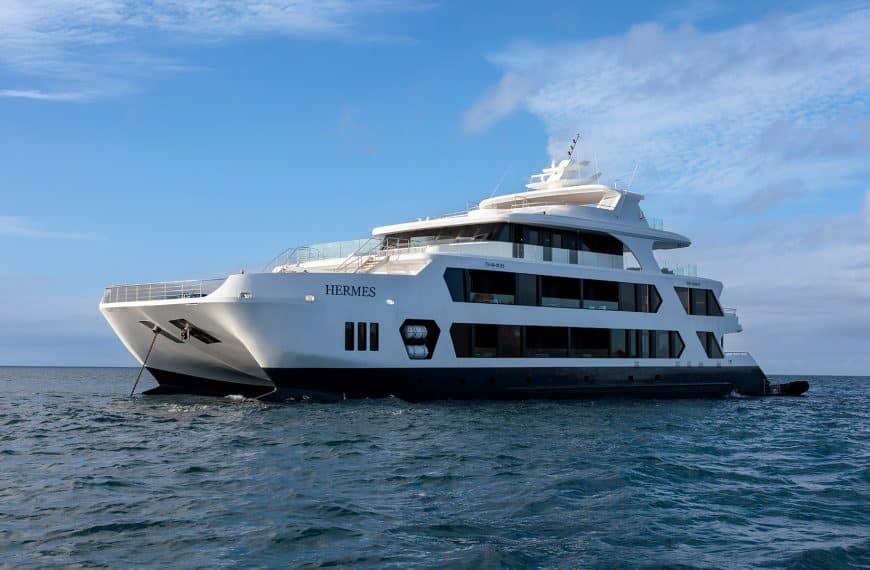
The Hermes earns her place on this list through solid construction and a hull design that handles the Galapagos waters well. She is not the largest vessel and she does not have a multi-hull advantage, but she is well-built, well-maintained, and rides the typical Galapagos swells with reassuring steadiness.
What we particularly appreciate about the Hermes for families is her combination of stability and intimacy. She is a smaller vessel, which means fewer passengers, a more personal atmosphere, and a closer relationship with your naturalist guide. For families who want a steady ride without the larger group sizes that come with bigger ships, the Hermes hits a sweet spot.
"Based on our experience, the Hermes is a well-built catamaran that offers excellent stability for her size. We recommend her to families who want a more intimate cruise experience without sacrificing comfort on the water — her twin-hull design keeps things steady, and the smaller guest count means your family gets more personal attention."Best for: Families who want good stability combined with a more intimate, small-group experience. A solid choice when motion sensitivity is a consideration but not the overriding concern.

Even on the most stable vessel, it is wise to come prepared. These are the strategies we recommend to every family, based on years of feedback from travelers.
We believe in being honest, even when it means recommending something other than a cruise. For some families, a land-based Galapagos itinerary is genuinely the better choice.
Consider land-based if:
A land-based trip does not mean missing out. You will still see giant tortoises, sea lions, marine iguanas, and extraordinary birdlife. You will snorkel in clear waters and walk volcanic landscapes. You simply will not reach the more remote islands that only cruise itineraries visit. For many families, especially those with stability concerns, that trade-off is absolutely worth making.

Stability is one piece of the puzzle. The right vessel for your family also depends on your children’s ages, your budget, the time of year, and which islands you most want to visit. As local experts who know these ships personally, we can help you weigh all of these factors — not just stability — and find the vessel that gives your whole family the best possible experience.
When you reach out, let us know if seasickness is a concern for anyone in your group. We will flag the smoothest options, suggest the calmest itineraries, and give you an honest assessment of what to expect. No family should miss the Galapagos because of a fear that can be managed with the right vessel choice.
Concerned about seasickness? Let us find your family’s smoothest ride.
Tell us about your family — ages, any motion sensitivity history, and your travel dates — and we will recommend the most stable vessels and calmest itineraries for your trip. We have helped hundreds of seasickness-worried families have incredible, comfortable Galapagos experiences.



