
Written by Marcelo Guerrero Oquendo, Co-Owner of Galapagos Insiders since 2015. Last updated May 2026.
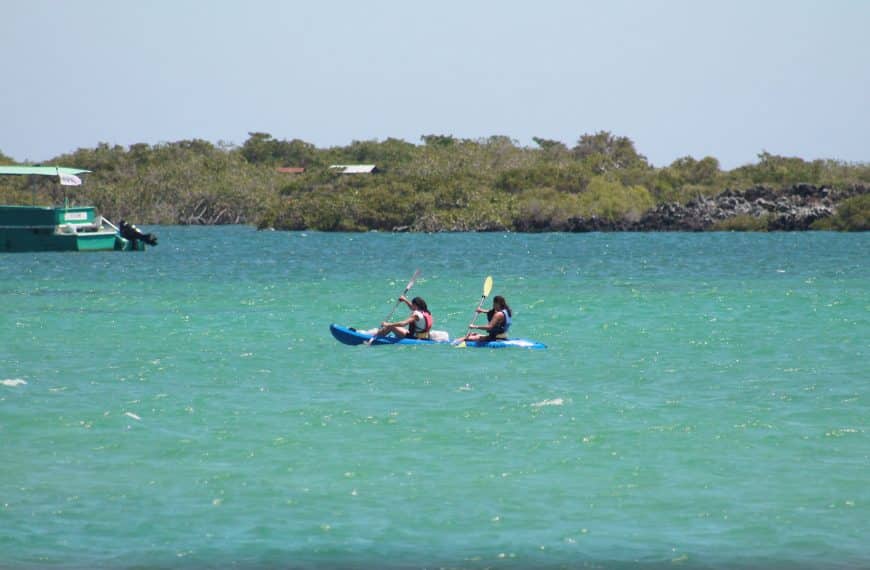
Kayaking in the Galapagos is real — but it is regulated, naturalist-supervised, and only allowed at a handful of approved sites. Here is where, when, and on which boat.
Talk with an expert insider — we'll match you to the right kayaking cruise in 24 hours.
USA & Canada 1-773-280-9571 · Ecuador +593-987-004-404 · [email protected]
The best Galapagos kayaking sites are Tagus Cove (Isabela, Western), Punta Vicente Roca (Isabela, Western), Elizabeth Bay mangroves (Isabela, Western), Santa Fe Bay (Eastern), and Darwin Bay on Genovesa (Northern). Kayaking in the Galapagos National Park is GNPD-regulated — you cannot freelance. You paddle from a vessel at a specific approved site, with a licensed naturalist guide in a panga shadowing the group, in a fixed time slot, with conditions-permitting cancellation built in. The warm season (December–May) brings the calmest seas and the most consistent kayak windows. The cool season (June–November) is paddle-able but choppier, especially on the Western route. Most cruises that "include kayaking" run 1–3 paddle outings across an 8-day itinerary — not daily — which is the single biggest expectation gap we correct at booking. Vessel kayak inventory varies by ship — we book Galapagos kayaking cruises across our portfolio of 38 GNPD-licensed vessels, the subset with onboard kayaks. Fleet-wide minimum-departure rates start from USD $1,530 (Budget), USD $1,816 (Mid-range), and USD $2,065 (Luxury), per person, double occupancy — these floors apply to the shortest 3-/4-day promo departures; a typical 8-day cruise runs roughly 2× these floors.
Every per-site condition note below is sourced from our own naturalist-guide observations and the GNPD site-permission list current as of {YYYY-MM-DD}. Not from generic operator marketing.

We've paddled every site on this list. The archipelago has a small, fixed list of Galapagos National Park Directorate-approved kayak sites — far smaller than the snorkel list. Five sites carry the reputation for actual paddling. Each one is governed by GNPD daily-visitor caps, licensed-guide rules, and site-specific conditions windows. Pick the wrong itinerary and "kayaking included" can mean one 45-minute paddle in a sheltered cove on Day 6 — not the trip you booked for.
Per-site availability above reflects what our GNPD-licensed naturalist guides log on a per-cruise basis, plus the operators we work with confirming current park rules. The GNPD revises site-permission lists on a calendar most travelers never see — what was kayak-approved last year may be conditions-restricted this year. We confirm the current per-site rules with the operator at booking, and again at the pre-cruise briefing on Day 1.

This is the part most kayaking pages skip. The Galapagos National Park does not permit freelance kayaking. You cannot rent a kayak at a town beach and paddle wherever you want. Every kayak outing inside the park boundary is tied to a vessel, a GNPD-approved site, a licensed naturalist guide, a fixed time slot, and a panga-supervised group — and it is conditions-cancellable at the guide's call.
A few specifics that change how you should plan the trip:
If your priority is paddling-volume, the Galapagos is not the trip. The Galapagos is what you do when you want to paddle the base of a 600-metre volcanic cliff with flightless cormorants 3 metres away, knowing it might be one of three outings that week. That trade-off is the trip.
A vessel is "good for kayaking" when four things line up. Onboard kayak inventory sized to the guest count (so the whole group can paddle one session, not rotate halves). A naturalist who actually runs the kayak briefing rather than handing it to the crew. A panga that shadows the kayak group rather than waiting at the vessel. And an itinerary that includes at least two of the marquee kayak sites (Tagus Cove, Elizabeth Bay, Santa Fe, Genovesa, Punta Vicente Roca) — which in practice means a Western or Northern route, or a longer 11–15-day combination.
Our 2026 luxury priority list confirms the vessels below. The cards are not the full kayak-program menu — they are the vessels we book most for travelers who told us kayaking matters.
Live next-departure feeds for the six vessels above:
Browse all 2026 luxury 8-day Western and Northern departures — the routes with the strongest kayak calendars:
Mid-range catamarans on the GI roster also carry kayaks. We've kept this list to luxury for one reason: kayak-program consistency (panga-shadow, naturalist-runs-briefing, inventory sized to the group) is most reliable on the luxury-fleet vessels. If your budget is mid-range and kayaking matters, talk with us — we'll match you to the right mid-range vessel that runs the marquee Western or Eastern kayak sites.

A typical Galapagos kayak outing runs 45–75 minutes on the water. The session usually launches mid-morning (after the day's first land or snorkel) or late afternoon (golden-hour light at Tagus Cove and Elizabeth Bay). Kayaks deploy from the vessel's stern platform or get loaded onto the panga and shuttled to the launch point. You'll suit up on the boat (most vessels supply a quick-dry layer; you wear your own swimwear and reef-safe sunscreen underneath), board the kayak two-up or solo, and follow the naturalist's planned route inside the bay or along the cliff base.
The naturalist briefs three things before the launch: the route inside the GNPD-approved boundary, the panga signal that means "come back now" (a single horn or a raised paddle), and the exit plan. On exposed sites — Punta Vicente Roca, the open mouth of Genovesa — the briefing also covers the conditions trigger that would cancel the session mid-paddle. We've seen Punta Vicente Roca called 15 minutes into the session when an unexpected swell came through; the panga collected the group, the vessel ran the snorkel instead, and the kayak rolled into the next day's calendar.
Most Western 8-day cruises run 2–3 kayak outings (Tagus Cove, Elizabeth Bay, sometimes Punta Vicente Roca). Most Eastern 8-day cruises run 1–2 (Santa Fe, occasionally a sheltered Floreana cove). Northern itineraries add Darwin Bay on Genovesa.
The Galapagos has two seasons, and kayaking looks different in each. Warm season (December–May) brings calmer seas, water at 20–26°C, and the most consistent kayak windows on the open-ocean Western sites (Punta Vicente Roca, Genovesa). Cool season (June–November) brings the Cromwell and Humboldt currents, choppier surface conditions on the Western route, and a higher rate of weather-cancelled kayak sessions at the exposed sites — but it also brings the wildlife density (penguin activity, sea-lion pups, hammerhead schools at the snorkel sites) that the cool season is famous for. Sheltered sites (Tagus Cove, Elizabeth Bay, Santa Fe, Darwin Bay) paddle reliably in both seasons.
The trade-off is real. If you want the highest kayak-session reliability, you book April–May or November–December — shoulder seasons with the calmest seas and the lowest conditions-cancellation rate. If you want the wildlife density, you book July–October and you accept that one of your two Western kayak sessions might be called by the guide.
| Month | Sea state (Western) | Kayak reliability (open sites) | Top wildlife event | Best route | Cost tier |
|---|---|---|---|---|---|
| January | Calm | High | Marine iguana mating display; sea turtle nesting | Eastern / Western | Mid-range to high |
| February | Calm | High | Flamingo nesting; warmest water | Eastern / Western | High (peak) |
| March | Calm | High | Marine iguanas grazing underwater; reef-fish density | Western | Mid-range |
| April | Calm | Highest | Waved albatross arrives Española; sea turtle hatchlings | Eastern / Western | Mid-range |
| May | Calm | Highest | Blue-footed booby courtship dance peaks; sea conditions calm | Eastern / Western | Mid-range |
| June | Building | Mid | Garúa mist starts; whale-shark season opens at Darwin/Wolf | Western / Northern | Mid-range |
| July | Choppy | Mid (Western) / High (sheltered) | Hammerhead schools peak at Kicker Rock; first Mola mola at Punta Vicente Roca | Western | Mid-range to high |
| August | Choppy | Lowest at Punta Vicente Roca | Whale shark season peak (Darwin/Wolf, dive-only); rough seas Western | Northern (sheltered Genovesa) / Eastern | High (peak) |
| September | Choppy | Low (Western) / High (Eastern + Genovesa) | Sea-lion pups widespread; cheapest month per cost guide | Eastern (calmer) | Lowest |
| October | Easing | Mid | Whale sharks taper; sea-lion pups | Eastern / Western | Low |
| November | Calming | High | Transitional; sea calms; visibility recovers | Eastern / Western | Low to mid-range |
| December | Calm | High | Warm season returns; green sea turtles nesting | Eastern | High (holiday peak) |
Suits. Travelers who want one or two genuinely memorable paddle sessions inside a wider wildlife trip. Beginners with reasonable upper-body fitness — most sites are sheltered and the panga shadows you. Intermediate sea-kayakers who have always wanted to paddle the base of a volcanic cliff with flightless cormorants 3 metres away. Couples and small groups who like the slower pace of a paddle compared with a snorkel. Travelers who picked the Western or Northern route specifically for the kayak calendar.
Doesn't suit. Travelers expecting daily multi-hour kayaking — Galapagos cruises do not run that program, and any operator promising it is selling you a story. Anyone unable to board a panga ladder unassisted (the panga is the safety boat; you must be able to re-board it). Anyone strongly motion-sensitive on a Western itinerary in cool season — even a sheltered kayak session sits inside a vessel-day that has open-ocean transits at the bookends. Solo paddlers expecting freelance access to the park — that is not how the Galapagos works.
Fitness reality. Kayak sessions are 45–75 minutes; mostly easy paddling in sheltered water; intermittent stronger strokes on the open-ocean sites. The panga ladder requires upper-body lift roughly 1 metre off water level. There is no upper age limit set by the operators we book — the oldest GI kayaker in 2025 was .
— , Galapagos Insiders
When this lands, the editor moves the practical implication paragraph below into the live page so the quote earns its placement. Until then, the page does not invent a quote.
Kayaking pairs naturally with snorkeling — same gear bag, same wetsuit, often the same panga slot — and with the dry-landing wildlife walks. If you want a water-focused trip, ask us about an itinerary that anchors snorkel + kayak + beach for the activity rotation. Hiking is the dry-day counterweight; most cruises alternate wet and dry days by GNPD design.

A Santa Cruz–based or Isabela-based traveler can do a half-day guided kayak from Puerto Ayora (Tortuga Bay channel area, conditions-dependent) or from Puerto Villamil (Concha de Perla lagoon, sheltered). Both are real and worth the morning. What you don't reach from a hotel base is Tagus Cove, Elizabeth Bay, Punta Vicente Roca, or Darwin Bay on Genovesa. The marquee kayak sites are GNPD-allocated to liveaboard cruise itineraries. If kayaking is a priority and you've ruled out a cruise (budget, time, mobility, motion-sickness), be open about the ceiling — you'll paddle a sheltered town lagoon with sea turtles, not a volcanic cliff base with flightless cormorants. For most travelers who want the marquee paddle, a 5- or 8-day cruise is the trip.
| Approach | Marquee kayak sites accessible | Kayak sessions | Best for |
|---|---|---|---|
| Cruise (5–8 day, Western) | Tagus Cove, Elizabeth Bay, Punta Vicente Roca | 2–3 sessions | Travelers who picked the route for the paddle |
| Cruise (5–8 day, Eastern) | Santa Fe, occasional Floreana cove | 1–2 sessions | Kayak as part of a wider wildlife trip |
| Cruise (Northern) | Darwin Bay (Genovesa) + Eastern coverage | 1–2 sessions | Genovesa seabird island + sheltered paddle |
| Land-based (Santa Cruz / Isabela hotels) | Tortuga Bay channel, Concha de Perla, day-tour coves | 1–3 day-tour sessions | Time budget under 5 days, budget cap, mobility constraints |
| Hybrid (4-day land + 4-day cruise) | Most cruise marquee sites + day-tour flexibility | 3–5 sessions | Best of both, longer trip |
For travelers who want the kayak day without the full cruise commitment, a few of our partner vessels run a charter day-trip kayak itinerary out of Puerto Ayora into Daphne Major's protected channel. Pablo and his wife sailed the Anahi Catamaran in October 2025 — a midrange catamaran — and described the guide and crew's flexibility to "catch opportunities as they came up" as the difference between a scheduled-itinerary trip and a real one. That flexibility is what makes the kayak session work when the morning slot at Punta Vicente Roca gets called.
→ Galapagos land-based tours 2026 — land-based kayak options when a cruise isn't right for you.
Yes — kayaking is permitted at a small number of Galapagos National Park Directorate-approved sites, with a licensed naturalist guide, a panga shadowing the group, and a fixed time slot. You cannot freelance. The marquee kayak sites — Tagus Cove, Punta Vicente Roca, Elizabeth Bay, Santa Fe Bay, Darwin Bay on Genovesa — are accessible only on cruise itineraries. Town-based day kayaks at Tortuga Bay and Concha de Perla are the land-based equivalent.
Tagus Cove (Isabela, Western) is the most-paddled marquee site — sheltered caldera-rim cove with flightless cormorants and penguins at the waterline. Elizabeth Bay (Isabela, Western) is the calmest paddle on the route — protected mangrove channels with eagle rays and sea turtles. Santa Fe Bay (Eastern) is the easiest paddle in the central archipelago, with a sea lion colony at the beach. Darwin Bay on Genovesa (Northern) is the seabird-island paddle inside a flooded caldera. Punta Vicente Roca (Western) is the most weather-dependent — the marquee cliff-base paddle, conditions-cancellable.
Warm season (December–May) brings the calmest seas and the highest kayak-session reliability on the open-ocean Western sites. April–May and November–December are the highest-reliability shoulder windows. Cool season (June–November) is paddle-able at the sheltered sites (Tagus Cove, Elizabeth Bay, Santa Fe, Darwin Bay) but sees a higher rate of conditions-cancellation at Punta Vicente Roca and exposed Genovesa entries.
Most 8-day Galapagos cruises include 1–3 kayak outings across the week — not daily. Western itineraries run 2–3 (Tagus Cove, Elizabeth Bay, sometimes Punta Vicente Roca). Eastern runs 1–2 (Santa Fe, occasionally a sheltered Floreana cove). Northern adds Darwin Bay on Genovesa. The single biggest expectation gap we correct at booking is "we'll be kayaking every day." You won't.
No — most marquee sites (Tagus Cove, Elizabeth Bay, Santa Fe, Darwin Bay) are sheltered, calm, and beginner-friendly. Punta Vicente Roca is intermediate (open coast, conditions-dependent). Comfortable upper-body fitness for a 45–75-minute paddle and the ability to board a panga ladder unassisted are the practical minimums. The naturalist briefs the route, the panga signal, and the exit plan before every launch.
Yes — vessels with kayak programs supply the kayaks (most are sit-on-top tandems), paddles, and personal flotation devices at boarding. You wear your own swimwear and reef-safe sunscreen (required by GNPD); bring a quick-dry top and a wide-brim hat for sun cover. A 3 mm shorty wetsuit is available on most vessels for cool-season Western paddles.
Yes — Santa Fe Bay (Eastern) is the most reliable site for a curious-juvenile sea lion approach during the kayak. Tagus Cove and Punta Vicente Roca (Western) are the most reliable sites for paddling alongside Galapagos penguins at the waterline. Galapagos sea lions are protected under GNPD rules — a 2-metre minimum distance applies, but the sea lions don't always read the rule.
Open-ocean kayak sites — Punta Vicente Roca, exposed Genovesa entries, occasional Western route segments — are conditions-cancellable at the naturalist's call on the morning of the session. Swell, wind, current, and group safety drive the call. The vessel still runs the alternate (panga snorkel, dry landing, or repositioned kayak slot later in the week). Kayak slots are not refunded individually because they are part of the itinerary, not a paid extra.
Inquiry → 24-hour proposal → 30% deposit holds the cabin → balance 60 days before sailing. We confirm the kayak-program details (which sites the route covers, vessel kayak inventory, naturalist briefing policy) at proposal stage so you don't find out at boarding. USA & Canada 1-773-280-9571 · Ecuador +593-987-004-404 · [email protected].
A kayak-included Galapagos cruise in 2026 runs $4,500–$11,320+ per person all-in (cruise + flights + park fee + tips), depending on vessel class. Kayaking is included in the standard cruise rate at every vessel above — there is no per-session kayak fee. See Galapagos Cruise Cost 2026 for the line-by-line breakdown.
"Our six-day stay aboard the Galapagos Sea Star yacht was truly the highlight of the trip. The crew members were exceptional — warm, attentive, and genuinely passionate about making our experience unforgettable. Our naturalist was extremely knowledgeable. Every excursion felt special, and her enthusiasm made a lasting impression on all of us."
Karen C. from New York City (Tripadvisor Review) — Galapagos Sea Star, March 2026
"Amazing boat and crew, great food, great excursions. A great display of flexibility from the guide and the crew to catch opportunities as they came up."
"Our group of 5 had a wonderful trip to the Galapagos with the assistance of Galapagos Insiders on the Hermes cruise. Everything was well organized, and Evelyn was great to work with from the beginning. The Hermes cruise was fantastic, and the whole experience exceeded our expectations."
Tim M. from Grand Rapids, Michigan (Tripadvisor Review) — Hermes, February 2026
Aggregate rating across our review sources: 4.9 / 5 across 350 verified reviews (2021–2026) — TripAdvisor, Trustpilot, Google Business Profile, WeTravel.
None of the testimonials above is kayak-specific — that's an limitation of our 2025–2026 review corpus.
24-hour quote. No-pressure proposal. We'll match you to the right vessel, the right month, and the right route — and we'll tell you the realistic kayak-session count for your itinerary before you book, not after.
USA & Canada 1-773-280-9571 · Ecuador +593-987-004-404 · [email protected]
We grew up here. Let us show you home.



