Everyone asks it first: am I experienced enough to dive the Galapagos? It's the right question, because these aren't warm, calm reef dives. Here's the candid answer: the logged-dive range, the certification level, and the current and cold-water experience that actually decide whether a liveaboard here is a fit, and why the numbers shift from one boat to the next.
Across the two liveaboards we book, Calipso and Galaxy Diver II, we generally ask for Advanced Open Water certification, 30 to 50 logged dives depending on your itinerary, and real drift and current experience, more if your route pushes north toward Darwin and Wolf. Galapagos dive sites run strong currents and thermoclines that can drop toward 16°C (61°F). Nitrox is optional on both rather than required, and unlimited fills are included free for certified nitrox divers. We confirm your exact dive count and certification requirement before booking. Current departures and starting prices are in the table below.
Diving the Galapagos isn't the same sport as diving a calm reef in the Caribbean. The water is remote, cold in places, and current-driven, and that's exactly why the requirements below exist. Every liveaboard we book weighs three things before it confirms your cabin: your certification level, how many dives you've logged, and how much real drift and current experience you carry. This isn't gatekeeping for its own sake.
Picture holding a reef hook at a cleaning station, current pulling steadily at your fins, while a wall of hammerheads stacks overhead in the blue. A boat needs to know you can handle that before it puts you in the water there. For most divers, a Galapagos liveaboard is not where you take your first ocean dives. Start with our Galapagos diving hub if you're still weighing a liveaboard against day-diving.
Advanced Open Water is the certification most Galapagos liveaboards ask for, and there's a real reason behind it, not just a rule for its own sake. AOW certifies you for deeper dives and a wider range of conditions than Open Water does, and Galapagos sites regularly call on both. On the two liveaboards we book, Calipso and Galaxy Diver II, AOW is generally the baseline, alongside the logged-dive range below.
If you're still Open Water certified, you're not automatically out. Day-diving from a land base, or a lighter Galapagos itinerary, can be realistic. What's out of reach with an Open Water card alone is the far north: Darwin and Wolf are built for advanced divers, and that isn't the trip to learn on. To be precise about it: Open Water is the technical floor on both boats, but it is only accepted with proven deep and drift specialties and real experience in current — Galaxy Diver II also wants 50 dives behind it before it will consider an Open Water card. In practice, Advanced Open Water is the baseline, because the northern profiles run to 30 metres.
Deep and drift specialty courses are the common step up from Open Water toward liveaboard-ready, and worth booking well ahead of your trip rather than squeezing in a rushed refresher the week before you fly.

Across the two liveaboards we book, Calipso and Galaxy Diver II, the general range we ask for is 30 to 50 logged dives, depending on the itinerary and the dive sites it includes. That's higher than most Caribbean or Southeast Asia liveaboards ask for, and it's set that way for a reason: Galapagos sites run colder, faster, and less forgiving than a typical liveaboard destination.
There is no single number that applies to every booking. A shorter, more central itinerary can sit toward the lower end of that range. An itinerary that pushes north toward Darwin and Wolf can call for more logged dives, or a closer look at your experience, before the operator confirms your cabin. We verify the exact figure for your specific itinerary before we confirm anything, rather than quoting one number and hoping it fits.
There is a second requirement that catches more people out than the logbook total: both vessels want at least one logged dive within the six months before you board. A pool refresher does not satisfy it. If you have been dry for a year, that is something to fix at home or on a day boat before you fly, not something to discover at the check-out dive.
"The card people show me is Open Water and the logbook says twelve dives, all of them in warm, flat water on holiday. That is not a qualification problem, it is a conditions problem. Darwin and Wolf are negative entries into current, holding onto bare rock at thirty metres in sixteen-degree water. I would rather tell someone at the enquiry stage that they need another season of diving than watch them have a frightening week they paid a lot of money for."
— Evelyn Duran, Co-Owner
A raw dive count only tells part of the story. What actually decides whether you're ready is current experience, because Galapagos diving involves negative entries, reef hooks, surge, and the occasional down-current, on top of water that runs colder than most divers expect from a destination this close to the equator. A diver with 60 logged dives from warm, calm water can still be underprepared here, while a diver with fewer dives but real current experience from somewhere like Cocos or Socorro can be a better fit.
Darwin and Wolf sit at the demanding end of that range. These are the far-north sites known for schooling hammerheads and pelagic action, and they're built for divers who already have current and drift experience, not for a first taste of it. Our guide to diving Darwin and Wolf covers what those two sites actually demand.
Water temperature is a planning fact, not a footnote. Thermoclines from the cold, nutrient-rich Humboldt Current can drop the water sharply as you descend, even when the surface feels comfortable. We cover the full breakdown, by month and by site, in our guide to Galapagos sea currents.
"What I want to see before I put someone on a northern itinerary is fifty dives minimum, and a hundred if they are going between June and November, plus something recent. The number in the logbook matters less to me than when the last entry was. A diver with eighty dives who has not been in the water for two years worries me more than one with fifty who was diving last month. The current up there does not care how long ago you were good."
— Marcelo Guerrero, Co-Owner
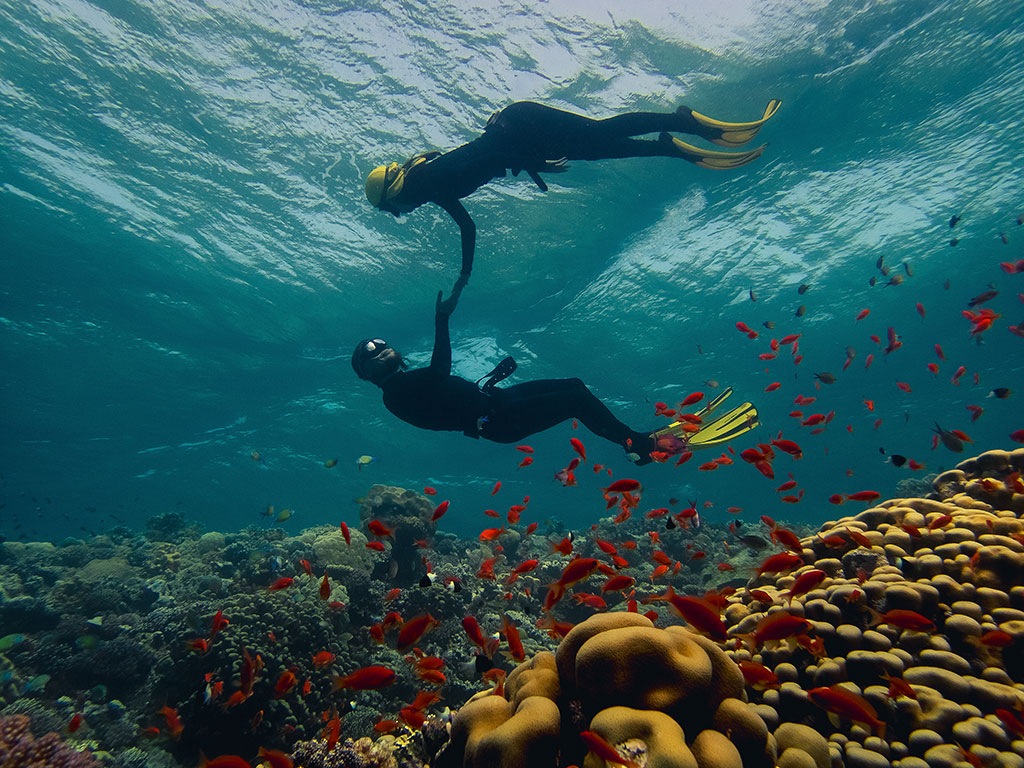
Nitrox certification is common on Galapagos liveaboards, for a practical reason: it extends your bottom time across repetitive daily dives on a multi-day itinerary. Nitrox is optional on both Calipso and Galaxy Diver II rather than mandatory, and both strongly advise it for the repetitive deep profiles the itineraries run. The good news is that it costs you nothing extra: unlimited nitrox fills are included in the fare for certified nitrox divers on both boats. If you are not certified, both can run the certification course on board for a fee.
Cold water changes your gear list too. Expect to want thicker exposure protection than a typical tropical liveaboard, Gear is rented, not included. A full kit — BCD, regulator, 7 mm suit, hood and booties — is hired by the week on both boats, and a dive computer is mandatory for every diver and rents separately. What is free on both is the safety kit: SMB, dive alert, and a personal locator unit. A 7 mm full wetsuit and hood are required year-round, because the thermocline takes 22–26°C surface water down to 16°C or colder at depth. On gloves, the park restricts them generally, but guides on both boats permit 3–5 mm gloves at Darwin and Wolf purely for holding bare volcanic rock at the lookout points — never on surface swims and never near coral.
Dive insurance, ideally DAN or an equivalent policy that covers decompression illness, is close to a universal expectation on any serious liveaboard, Galapagos included. On these two boats it is not an expectation but a hard requirement: no valid hyperbaric policy, no diving.
Both vessels run a mandatory check-out dive on day one or early day two, and it is a real assessment rather than a formality. Calipso does it at Lobos Island or Carrion Point in 3 to 10 metres; Galaxy Diver II at Baltra Northeast in a sheltered 5 to 12 metres. The guides use it to set your weighting for a 7 mm suit in high-salinity water, check that rented kit works, and watch your buoyancy and trim before they clear you for the high-current drift dives up north. On safety, both carry a large oxygen bank with portable units for the pangas, an AED, personal locator beacons, and satellite communications. Dive insurance with explicit hyperbaric cover is 100% mandatory on both — the archipelago has one chamber, in Puerto Ayora, and a boat transit from Darwin can take over 14 hours.
Here's the whole picture in one table. Treat the middle column as our general guidance from the two liveaboards we book, not an industry-wide rule.
| Requirement | General expectation | Set by the operator? |
|---|---|---|
| Certification | Advanced Open Water (or equivalent) | Yes — generally the baseline on both liveaboards we book |
| Logged dives | 30 to 50, depending on itinerary | Yes. 30 for central-island itineraries in the warm season; 50 for Darwin and Wolf December to May; 100 recommended and enforced June to November |
| Drift / current experience | Expected; essential for Darwin and Wolf | Yes — set per operator and itinerary |
| Nitrox | Often required or strongly favored | Optional on both, strongly advised, and included free for certified nitrox divers |
| Dive insurance (DAN or equivalent) | Near-universal expectation | Verify at booking |
The "general expectation" column above is guidance drawn from the two liveaboards we book, not a universal industry rule. The operator's own policy for your specific itinerary governs, and we confirm it before you deposit.
If you're short on certification or logged dives right now, that's a plan, not a no. Most divers who eventually book a Galapagos liveaboard started somewhere else, building toward it a season or two out. The progression is straightforward: Advanced Open Water first if you don't have it, then drift and deep specialty courses, then logged dives in current, ideally somewhere with real current, not only flat, calm water.
Neither boat arranges a warm-up dive, and it is not obstinacy — national-park permits fix the embarkation schedule and the vessels cannot move transit times for one guest. What we do suggest for anyone short on recent dives is to build your own: do a refresher at home if you have been inactive more than six months, then fly into Santa Cruz or San Cristóbal two or three days early and take a couple of two-tank day trips from Puerto Ayora. That sorts your weighting in local salinity, tests your kit, gets you practising panga entries, and satisfies the six-month recency rule before you ever step onto the liveaboard.
Give us the real picture of where you stand, certification, logged dives, and what kind of water you've dived in, and we'll tell you plainly whether you're ready now or what to build first. That's a different trip from a wildlife-and-snorkeling naturalist cruise, so if diving isn't the main goal, our naturalist cruises are the better starting point instead.
Talk with an expert insider — tell us your dive experience and we'll tell you which liveaboards fit.
USA & Canada 1-773-280-9571 · Ecuador +593-987-004-404 · [email protected]
Across the two liveaboards we book, Calipso and Galaxy Diver II, the general range is 30 to 50 logged dives, depending on the itinerary and dive sites included. Itineraries that push toward the northern Darwin and Wolf sites can call for more, or a closer look at your logged experience. There's no single universal number: we confirm the exact figure for your specific itinerary before booking.
Generally, yes. Most Galapagos liveaboards, including the two we book, ask for Advanced Open Water as the baseline. AOW covers deeper dives and a wider range of conditions than Open Water, both of which Galapagos sites call on regularly. Open Water is accepted only as an exception, and only with deep and drift specialties plus genuine current experience behind it — Galaxy Diver II also wants to see 50 logged dives. Assume AOW is what you need.
Not easily, and not on the northern itineraries. A true beginner is better served starting with day-diving or a Galapagos snorkeling trip, then building toward a liveaboard over time. If you're newer but motivated, tell us your experience and we'll map out what to build, certification, logged dives, and current experience, before a Galapagos liveaboard makes sense for you.
Yes. Darwin and Wolf are the far-north sites known for strong currents, negative entries, and reef-hook diving at cleaning stations, and operators expect divers to already have that experience, not gain it there. A diver with plenty of warm, calm-water dives but no current experience can still be underprepared for these two sites specifically.
It depends on the operator. Nitrox is common on Galapagos liveaboards because it extends bottom time across repetitive daily dives, and many boats require or strongly favor it. On our two, it is optional rather than required — and unlimited fills are included in the fare for certified nitrox divers, so there is little reason not to use it.
Not on a liveaboard itinerary. Galapagos liveaboards are built for certified divers with logged experience, not first-time instruction. If you want to learn to dive before a Galapagos trip, we'd point you toward certification beforehand, then building logged dives and current experience toward a future liveaboard.
It carries real risk for underprepared divers, mainly from strong currents, down-currents, and cold thermoclines rather than the marine life itself. That's exactly why the certification and logged-dive expectations exist: they're a filter, not a formality. Divers who arrive with the current experience these sites call for report a demanding but safe trip.
Live availability and starting prices for our Galapagos departures. Dates and rates update automatically.
Tell us your certification, your logged-dive count, and the kind of water you've dived in, and we'll tell you plainly which of our two liveaboards fits, or what to build first if neither does yet.
USA & Canada 1-773-280-9571 · Ecuador +593-987-004-404 · [email protected]
Comparing formats first? Start with our Galapagos diving hub, or see how a liveaboard compares with day-diving before you book.