

There's something deeply satisfying about a checklist. Kids know this instinctively — give a seven-year-old a list of things to find, and suddenly every walk becomes a mission. The Galapagos has its own version, and it's spectacular: the Big 15, the fifteen most iconic species you can encounter across the archipelago.
Unlike Africa's Big Five (which require patience, distance, and a good pair of binoculars), the Galapagos Big 15 are remarkably approachable. These animals have never learned to fear humans. Your children won't be squinting through a telephoto lens — they'll be standing a meter away from a blue-footed booby performing its mating dance, or watching a marine iguana sneeze salt onto the rocks beside them.
We've helped hundreds of families plan their Galapagos trips, and the Big 15 checklist has become one of our favorite tools for keeping children engaged throughout a cruise or island-hopping tour. Here's every species, where to find them, and which itineraries give your family the best chance of ticking off the entire list.
The Big 15 is an unofficial but widely recognized list of the fifteen most iconic Galapagos species — the animals that define these islands and that most visitors hope to see. Some are abundant (you'll trip over Sally Lightfoot crabs within minutes of landing). Others require specific islands and specific timing. Part of the fun is that no two trips produce exactly the same sightings.
For families, the Big 15 transforms a nature trip into a game. We've seen children who were initially reluctant about "another walk on rocks" become completely absorbed once they had a checklist in hand. There's real pride in spotting a flightless cormorant before your parents do.
Here's the complete list, with everything your family needs to know about each one.
Where: North Seymour, Espanola, San Cristobal. Common across many islands year-round (courtship peaks June-August).
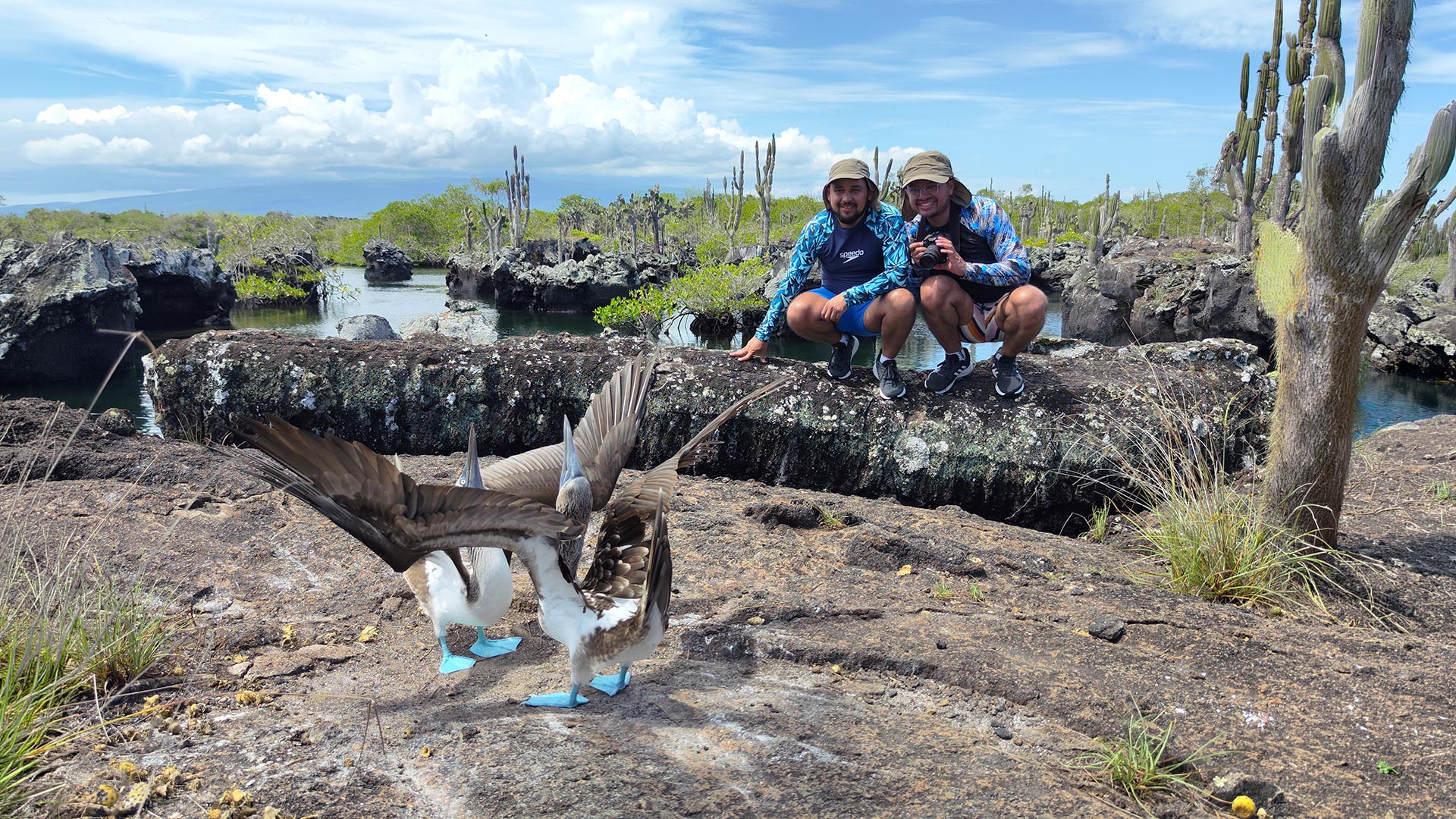
Fun kid fact: The bluer the feet, the healthier the bird. Males lift their bright blue feet in a slow, exaggerated dance to impress females. Children find this hilarious every single time. You'll almost certainly see them on any multi-day itinerary.
Where: Espanola, Genovesa, San Cristobal (Punta Pitt). Year-round.
Fun kid fact: The largest of the three Galapagos boobies, with striking white plumage and a black mask — kids say they look like they're wearing a superhero costume.
Where: Genovesa (best spot) and San Cristobal (Punta Pitt). Year-round at Genovesa.
Fun kid fact: The only boobies that nest in trees, and they come in two color forms — brown and white. Ask kids to count how many of each they spot. Genovesa is in the far northeast, so if this species matters to your family, itinerary choice is critical.
Where: Espanola only — the sole breeding site on Earth. April to December only (they leave entirely from January to March).
Fun kid fact: Their wingspan reaches over two meters. Pairs perform an elaborate "fencing" dance, clacking beaks together like sword fighters. One of the most memorable encounters in the Galapagos — but miss the season window and you won't see them at all.
Where: North Seymour (best for the red pouch display), Genovesa, Floreana, San Cristobal. Year-round; males inflate red pouches primarily March-April.

Fun kid fact: Males blow up their bright red throat pouch like a balloon to attract females overhead. Also, frigatebirds are sky pirates — they steal food from other birds mid-flight. Kids are mesmerised.
Where: Isabela (Tagus Cove, Elizabeth Bay), Fernandina, Bartolome. Year-round; more active June-November.

Fun kid fact: The only penguins north of the equator — tiny (50cm tall) and incredibly fast underwater. Children are always stunned that penguins live somewhere tropical. Western itineraries offer the best chances; see our guide to guaranteed penguin sightings for families.
Where: Isabela and Fernandina only. Nowhere else on Earth. Year-round.
Fun kid fact: This bird forgot how to fly. Over thousands of years, its wings shrank to tiny stubs. It still spreads them out to dry after swimming — which looks wonderfully silly. Requires western island itineraries.
Where: Floreana (Punta Cormorant lagoon), Isabela, Santa Cruz (Las Bachas), Rabida. Year-round but numbers fluctuate.

Fun kid fact: Pink because of the shrimp they eat. Baby flamingos are gray — it takes two years to turn pink. Ask children to spot any gray youngsters. The Galapagos population is only a few hundred, so sometimes the lagoons are empty.
Where: Everywhere. Every island. Year-round. Males turn vivid red and green on Espanola during breeding season (December-March) — the "Christmas iguanas."

Fun kid fact: The only lizards in the world that swim in the ocean. After feeding on underwater algae, they sneeze out salt through glands in their nose. Children find the sneezing absolutely delightful.
Where: North Seymour, South Plaza, Isabela, Fernandina, Santa Cruz highlands. Year-round.
Fun kid fact: They can live over 60 years and grow up to a meter long. They eat cactus pads — spines and all. On South Plaza, watch them waiting patiently under cactus trees for a pad to fall.
Where: Santa Cruz (Darwin Research Station and highlands), Isabela, San Cristobal. Year-round; highlands best June-November.
Fun kid fact: They weigh over 250 kilograms and live well past 100 years — the oldest reached around 175. A tortoise alive today could have been born before your great-great-grandparents. See our guide to seeing giant tortoises with children.
Where: Everywhere. Beaches, docks, park benches, zodiac boarding areas. Year-round.
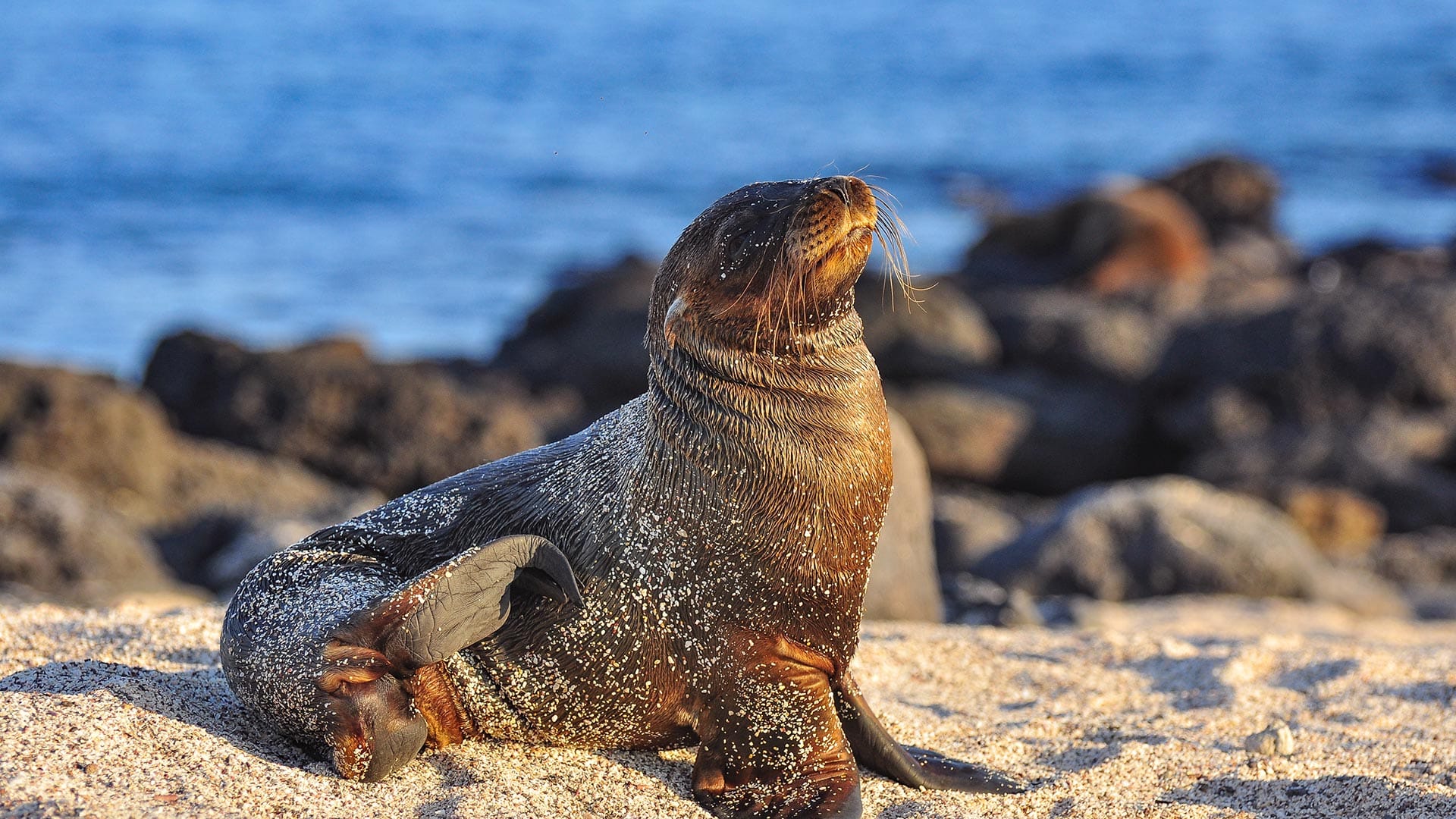
Fun kid fact: While snorkeling, pups will swim right up to children and perform barrel rolls around them. Usually the single most talked-about moment of any family trip. You cannot avoid them — they'll be lying on your zodiac when you get back.
Where: Santiago (James Bay), Genovesa, Isabela. Prefer rocky, shaded coastlines. Year-round; more visible in cooler months.
Fun kid fact: Despite the name, they're actually sea lions. Smaller and shyer than Galapagos sea lions, with bigger eyes and thicker fur. Tell kids to look for the teddy bear face — it helps distinguish them. Santiago is the most reliable spot.
Where: Every island. Every rocky shoreline. Year-round.
Fun kid fact: Adults are bright orange and red, but juveniles are black for camouflage. Challenge your children to spot the tiny black ones hiding among the adults. They can run in four directions at once. They'll be the first Big 15 species your family ticks off.
Where: Every island. At least 13 species. Year-round.
Fun kid fact: These small brown birds changed the history of science. Darwin noticed different beak shapes on different islands — some for cracking seeds, one that uses a stick as a tool — which helped spark his theory of evolution. Easy to see, hard to identify which species. Kids who learn to tell them apart earn serious bragging rights.
Not all Galapagos itineraries are created equal when it comes to the Big 15. Some routes focus on western islands (great for penguins, flightless cormorants, and marine iguanas), while others swing east or south (better for boobies and albatross). The itineraries that cover the widest range of islands give your family the best shot at a complete checklist.
Here are our top three recommendations for families chasing the Big 15:
The Ocean Spray is a first-class catamaran, which means excellent stability for families concerned about seasickness. Her Itinerary A covers both western and central islands, giving you strong chances at penguins, flightless cormorants, giant tortoises, all three booby species, and marine iguanas. The catamaran design also provides generous social spaces — important when children need room to move between excursions.
Big 15 potential: 12-14 species depending on season and conditions.
The Galapagos Horizon offers an itinerary that balances eastern and western island visits, which is exactly what you want for maximum species coverage. This route gives families realistic chances at some of the harder Big 15 targets, including fur seals and flamingos, while still guaranteeing the easy ones.
Big 15 potential: 12-14 species depending on season and conditions.
The Natural Paradise is a catamaran with a layout that works beautifully for families. Her Itinerary B provides excellent wildlife diversity, covering key sites for both the common and rarer Big 15 species. The vessel's stability and comfort make long days of wildlife spotting much more enjoyable for younger children.
Big 15 potential: 12-14 species depending on season and conditions.
"From our experience, the species you'll see depend heavily on the specific route and time of year, and we don't want to publish a list that sets the wrong expectations. What we do is match each family to the itinerary that gives them the best chance at the species they care about most — just tell us your top priorities and we'll build from there."Want to know which route is the best fit for your family's ages and interests? We can match your dates and priorities to the itinerary that maximizes your Big 15 chances. Get in touch and tell us which species are at the top of your list.
We strongly recommend printing a checklist before you go. Hand one to each child (and each adult — this isn't just for kids). Here's what to include:
For each species, leave space to record: the date spotted, the island, and one observation (what was it doing? how close were you?). This turns a checklist into a field journal — and a treasured souvenir. Younger children might prefer a version with pictures to color in. For more, see our educational trips guide.
For families with older children (or photography-minded younger ones), take the Big 15 a step further: make it a photography challenge. The rules are simple:
The Galapagos is uniquely suited to this kind of challenge because the animals don't run away. Children can take their time composing shots, experimenting with angles, and learning basic wildlife photography skills. A waterproof camera or a phone in a waterproof case is essential for underwater encounters — sea lion pup selfies are the ultimate prize.
For families who want to go deeper into wildlife photography, we've put together a complete guide to family wildlife photography tours in the Galapagos.
Most families on a well-chosen itinerary see 10 to 13 of the Big 15. Seeing all 15 requires a longer itinerary, the right season, and some luck. The waved albatross and red-footed booby are most commonly missed — both require specific islands that not every itinerary visits.
Honestly? That's part of the magic. Having species still unchecked gives families a reason to come back. We recommend an 8-day itinerary covering western and central-eastern islands for the best chance. Shorter 5-day cruises deliver 8 to 11 species comfortably. Read more in our complete family travel guide.
Tell us which species are at the top of your family's wish list, and we'll match you to the itinerary that gives you the best chance of ticking them all off. We know every route, every island, and every season — and we love helping families plan the perfect wildlife adventure.



