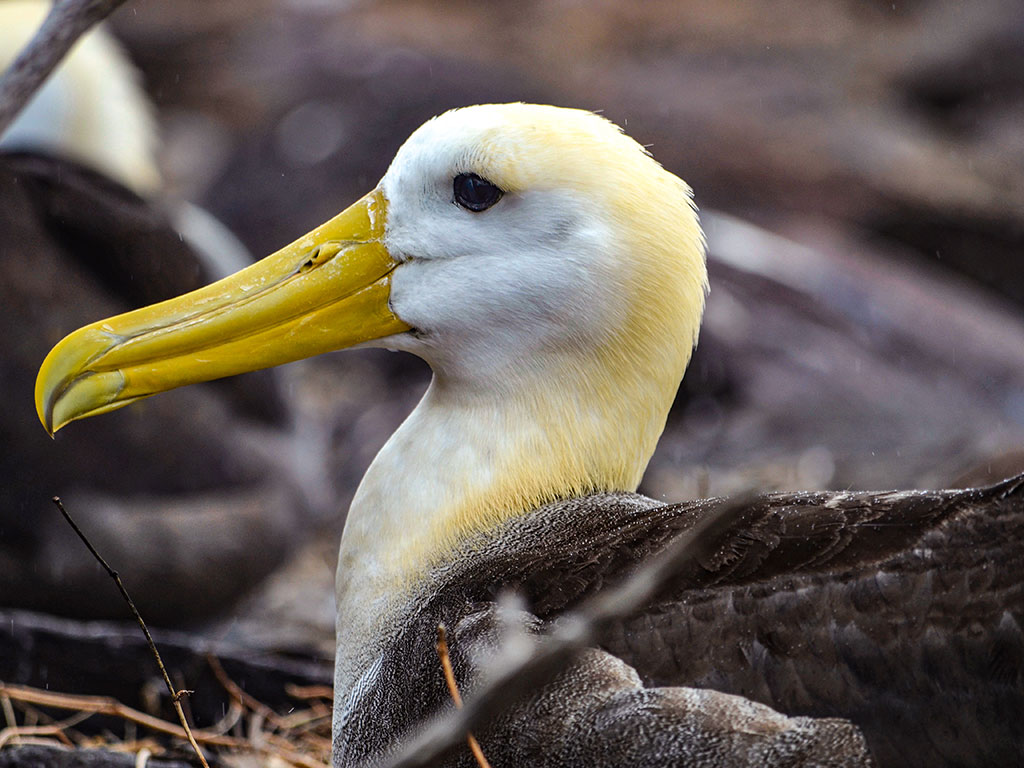
There's a moment on Espanola Island that stops every family in their tracks. Two Waved Albatrosses face each other, raise their beaks skyward, and begin a clattering, circling, bowing courtship dance that looks like something choreographed for a nature documentary. Your kids will stand there open-mouthed. So will you. And the birds won't care that you're watching — they'll keep going, completely unbothered, just a few meters away.
The Waved Albatross breeds only on Espanola Island in the entire world. They arrive around April, court, nest, raise their chicks, and depart by December. If your family visits during those months, you'll witness one of the most extraordinary wildlife spectacles the Galapagos has to offer. Miss the window, and the albatrosses are gone — out at sea, somewhere off the coast of Peru, until next year.
The Waved Albatross (Phoebastria irrorata) is the only tropical albatross species in the world, and it's endemic to the Galapagos. Here's what makes it unforgettable for families:
The first albatrosses begin arriving on Espanola in late March and early April. Males typically arrive first, returning to the same nesting area they've used for years. When their mate arrives — sometimes days later — the reunion courtship begins immediately. This is when you'll see the full "sword dance" at its most intense, as pairs re-establish their bond after months apart at sea.
What families see: Birds arriving, pairs reuniting, dramatic courtship displays. The colony is active but not yet crowded. Landing trails are relatively quiet.
By May, the colony is in full swing. Hundreds of pairs are courting simultaneously across Espanola's Punta Suarez headland. The noise is remarkable — bill-clacking echoes across the scrubland. Mating occurs, and females begin selecting nest sites. The birds are completely habituated to human visitors and will dance within arm's reach of the trail.
What families see: Peak courtship behavior. The best month for watching the sword dance. Chicks haven't hatched yet, so the drama is entirely between the adults.
Females lay a single large egg directly on the ground — no nest, just bare rock or soil. Both parents take turns incubating over a period of about two months. The colony becomes quieter as birds settle into the patient work of sitting on eggs. You'll still see courtship from late arrivals, and the sight of these enormous birds carefully tucking themselves over a single egg is surprisingly tender.
What families see: Incubating pairs, some late courtship, a calmer colony. Good for younger children who prefer a less intense atmosphere.
This is the phase that captivates children the most. Fluffy gray-brown chicks begin appearing from July onwards, growing rapidly as both parents shuttle food from the sea. The chicks are comically fluffy, surprisingly large, and completely fearless. They sit in the open, blinking at visitors, while their parents stand guard or waddle off toward the cliffs to launch another feeding run.
By September, chicks are nearly the size of adults but still covered in down. Watching a parent return and feed a chick — through regurgitation of stomach oil — is mesmerising and, yes, a bit gross. Kids love it.
What families see: Chicks at various stages, feeding behavior, adults launching from cliffs on foraging flights. The most family-friendly phase for sheer "cute factor."
The final act. Juvenile albatrosses, now fully feathered, begin practising their cliff launches. They waddle to the edge, spread their wings, hesitate, waddle back, try again. Some succeed on the first attempt and soar beautifully over the ocean. Others need a few tries. It's tense, thrilling, and oddly emotional — your family will find themselves cheering for each bird.
By December, almost all albatrosses have left Espanola. The island falls quiet until the following April.
What families see: Fledging attempts, cliff-edge drama, the final departures. Best for older children and teenagers who appreciate the narrative arc of the full breeding cycle.
Every month from April to December offers something worth seeing, but if you're planning specifically around the albatross, here's how we advise families:
If your family wants to witness the famous sword dance and the full intensity of albatross courtship, aim for late April through May. The displays are at their peak, the birds are highly active, and the spectacle is genuinely jaw-dropping. June is quieter but still rewarding, with incubation adding a different dimension.
Keep in mind that April to June falls within the warmer, calmer season in the Galapagos. Seas are generally smoother, water temperatures are warmer for snorkeling with kids, and the weather is sunny. This is also peak season for tourism, so booking early is important. See our best time to visit with families guide for the full seasonal picture.
Families with children aged 6 to 10 tend to love the chick-rearing phase. Fluffy baby albatrosses are irresistible to young eyes, and the feeding behavior sparks endless questions that your naturalist guide will happily answer. The colony is active but less frenzied than during courtship, making it easier for younger children to take in what they're seeing.
July to September is the cooler, drier season. The Humboldt Current brings nutrient-rich water, which means outstanding snorkeling — more marine life, better visibility — though the water and air are cooler. Pack layers and a light wetsuit for the kids.
The fledging phase appeals to families with older children and teenagers who can appreciate the tension and significance of a young albatross's first flight. It's a powerful metaphor that isn't lost on adolescents, and the cliff-edge takeoffs are genuinely dramatic. October and November are ideal — by December, most birds have departed.
Not every Galapagos cruise visits Espanola Island. The Galapagos National Park controls which vessels go where on which days, so your itinerary choice is critical if the albatross is a priority.
Espanola sits in the southeastern corner of the archipelago. It appears on eastern and southeastern itineraries, typically as a full-day visit to Punta Suarez (the albatross breeding site) and Gardner Bay (a stunning white-sand beach with sea lions).
When you contact us, tell us that Espanola is a priority, and we'll filter your options to itineraries that include it on the right day, on a family-friendly vessel. Not all 5-day or 8-day itineraries visit Espanola, so this is one of those cases where having a local expert match your dates to the right departure makes a real difference.
"From our experience, the key is booking an itinerary that visits Espanola during the right window — roughly April through December for albatross. We work with several vessels that include Espanola on their routes, and we match families to the best available departure for their dates. Tell us when you're traveling and we'll show you the options."The Waved Albatross is the headline act, but Espanola delivers a full day of wildlife encounters that justify the visit even outside albatross season. Here's what your family will see alongside the albatrosses:
Espanola hosts one of the largest Nazca Booby colonies in the Galapagos. These striking white birds with dark face masks nest right along the visitor trail. During breeding season, you'll see eggs, chicks at various stages, and adults performing their own courtship rituals. The Nazca Booby's sky-pointing display is simpler than the albatross dance but equally entertaining for kids.
At the southern tip of Punta Suarez, the ocean forces through a narrow gap in the lava rock and erupts in a geyser of spray that can reach 20 meters high. On a good swell day, the blowhole is spectacular — kids will want to watch it for far longer than your schedule allows. It's also one of the best spots on the island for photography, with the spray backlit against the sky.
Espanola's marine iguanas are the most colorful in the archipelago — during breeding season (roughly December to March), the males flush vivid red and turquoise-green. Even outside that window, Espanola iguanas are noticeably more vibrant than their relatives on other islands. They carpet the rocky shoreline, and your children will need to watch their step.
Most Espanola itineraries include a stop at Gardner Bay, one of the most beautiful beaches in the Galapagos. The white coral sand is shared with a large colony of Galapagos sea lions. Pups are playful, curious, and will approach snorkellers in the shallows. For families, this is often the emotional highlight of the day — the albatrosses are awe-inspiring, but swimming with sea lion pups is pure joy.
Found nowhere else on Earth, the Hood Mockingbird is endemic to Espanola. They're famously bold — they'll land on your hat, investigate your water bottle, and follow your family along the trail. Children find them endlessly amusing, and they're a great introduction to the concept of island endemism.

Here's our practical advice for families building their Galapagos trip around the Waved Albatross:
May (peak courtship) and July-August (chick-rearing with good weather) are the most popular months for albatross-focused visits. Itineraries that include Espanola on these dates fill quickly, especially on the best family vessels. We recommend booking at least 6-9 months in advance for these windows.
Most Galapagos cruises don't accept children under 6. The Espanola landing at Punta Suarez involves walking over uneven rocky terrain for about 2 hours — manageable for school-age children, but worth considering if your youngest is right at the minimum age. Talk to us about your specific family, and we'll advise honestly.
A family trip built around the albatross doesn't mean sacrificing other highlights. Eastern itineraries that visit Espanola typically also include San Cristobal (sea lion colonies, snorkeling at Kicker Rock), Floreana (flamingos, Post Office Bay), and Santa Cruz (the Charles Darwin Research Station, giant tortoises). Your children will see far more than albatrosses.
If your family has time for a longer trip, consider combining an eastern itinerary with a western itinerary for the complete Galapagos experience — penguins, flightless cormorants, and whale watching on the west, plus the albatross colony on the east.
The albatross experience is richer when children arrive knowing what they're about to see. Watch a short video of the Waved Albatross courtship dance before the trip — it builds anticipation and helps kids recognize the behavior when they see it live. Download the Big 15 species checklist and add the Waved Albatross as a priority species. For younger children, our wildlife scavenger hunt turns the entire trip into an interactive game.
We've guided hundreds of families to Espanola over the years, and the Waved Albatross never fails to deliver. There's something about watching a bird with a 2.4-metre wingspan perform a love dance three meters from your six-year-old that rewires how a family thinks about nature. It's not behind glass. There's no fence. The albatross is just there, doing what it has done on this exact spot for thousands of years, and your family gets to witness it.
The Waved Albatross breeds only here. Nowhere else in the world. When your children understand that — really understand it — something shifts. That's the Galapagos effect, and Espanola is where it hits hardest.
Tell us your family's ages, your preferred travel dates, and we'll find the right itinerary that visits Espanola during the albatross phase your family most wants to see.
USA & Canada: 1-773-280-9571
Ecuador: +593-987-004-404
Email: [email protected]