Couples ask us this before they ask us anything about boats: will we be comfortable, and is it safe? Here's the plain version: the law, what daily life actually looks like, and where we'd tell you to be a little more aware. Ecuador is part of this picture too, not just the islands, since the mainland cities you'll pass through are part of the trip.
Yes: Ecuador ranks among South America's more legally progressive countries for LGBTQ+ travelers. Same-sex marriage has been legal since 2019, the 2008 constitution explicitly bans discrimination based on sexual orientation, and same-sex activity was decriminalized back in 1997. Tourist hubs like Quito, Guayaquil, and the Galapagos are broadly welcoming to international visitors of every kind. As in much of the region, city and tourist-zone attitudes tend to run warmer than some rural areas, so a little awareness goes a long way. Current departures and starting prices are listed below.
The plain answer is yes, and it's a genuinely reassuring one. Ecuador legalized same-sex marriage in 2019, its constitution protects against discrimination based on sexual orientation, and homosexuality hasn't been a crime here since 1997. Ecuador ranks among the more progressive countries in South America on paper, and the tourist areas you'll actually spend time in, Quito, Guayaquil, and the Galapagos, back that up in practice. Where the picture gets more nuanced isn't the law itself: it's the gap between a big city and a small highland town, and between what feels comfortable in public versus in private. That nuance applies as much to the mainland leg of a trip as it does to the islands, so we're covering both here, not the archipelago on its own.
Start with the facts, because they're stronger than most travelers expect. Ecuador's Constitutional Court legalized same-sex marriage in June 2019, making Ecuador one of the earlier countries in South America to do so. The 2008 constitution goes further than marriage alone: it explicitly prohibits discrimination on the basis of sexual orientation, and it was written to recognize diverse family structures rather than a single traditional model. Same-sex sexual activity was decriminalized even earlier, in 1997, following a ruling that struck down the law that had criminalized it. Together, that's three decades of legal ground: decriminalization in the 1990s, constitutional protection from 2008, and marriage equality by 2019.
What that legal framework doesn't guarantee is uniform enforcement or uniform social attitudes in every part of the country, and we'd rather say that plainly than let the legal facts imply more than they do. A protection on paper is real, and it matters, especially for anything involving documentation, but it isn't a promise that every interaction, everywhere, will reflect it.
"Couples come to us assuming South America is one place with one attitude, and that they will have to be careful for the whole trip. Ecuador has had marriage equality since 2019, and the constitution has prohibited discrimination based on sexual orientation since 2008. That is the legal floor, and it sits higher than most people expect. What I will not do is tell you attitudes are identical everywhere, because they are not. I would rather give you the real picture of each place you are going than a brochure answer."
— Evelyn Duran, Co-Owner
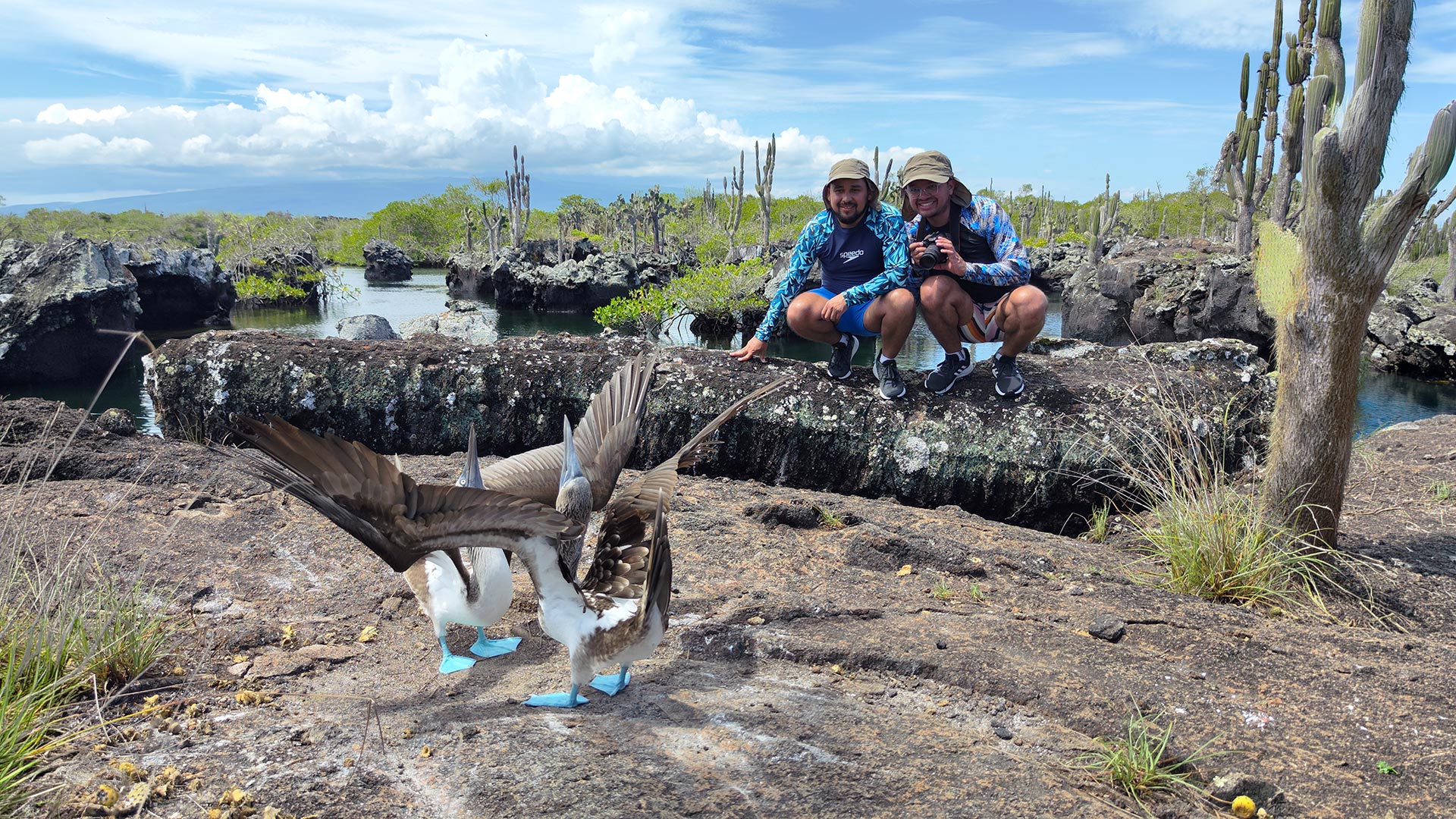
Cities and tourist zones are where most of your trip happens, and that's where Ecuador is most consistently comfortable. Quito's Mariscal Sucre district, Guayaquil, and the small towns you'll pass through in the Galapagos, Puerto Ayora chief among them, all see a steady flow of international visitors and are used to a mix of nationalities, ages, and relationships passing through. Nobody working in tourism there is going to blink at a same-sex couple booking a double cabin or a hotel room.
Candidly, Ecuador is a predominantly Catholic country, and like much of the region, attitudes can run more conservative outside the cities, especially in rural highland communities that see far fewer international visitors. Public affection draws a bit more attention in some of those places than it would in Quito or on a cruise deck. That's not a reason to avoid them; it's simply worth knowing going in, the same awareness you'd carry into a small conservative town in most countries. We're not going to tell you it's a non-issue everywhere, because it isn't, and we're not going to tell you it's a serious risk in the places you'll actually visit as a tourist, because for the vast majority of couples, it isn't that either.
The Galapagos itself is a small-town tourist environment layered on top of a cruise or lodge structure. Whichever islands you visit, you're moving through communities that see visitors from dozens of countries every week, and staff on board or on shore work with couples of every kind as a matter of routine, not as something unusual. For more on staying safe generally in the islands, see our guide to safety in the Galapagos Islands, and for the mainland leg, our Quito travel guide and tips covers the city you'll likely pass through both ways.
On board, day-to-day life is built around small groups: shared meals, a shared upper or main deck, daily briefings, and pangas out to the day's landing site. A same-sex couple books a double cabin the same way any couple does, eats at the same tables, and joins the same excursions. Nothing about the structure of a Galapagos cruise singles anyone out.
How welcoming any individual vessel feels can vary by crew and by ship, the same way it can on any cruise anywhere, so we're not going to claim every one of the 40 vessels in our network is equally warm; that's a fleet-wide promise we're not going to make. What we can tell you, and what we've seen directly:
"We've hosted same-sex couples on board a number of different Galapagos cruises over the years, and in our experience they've always been treated with the same professionalism, respect, and hospitality as any other passenger. No operator we work with markets itself specifically to LGBTQ+ travelers, because none of them need to; the boats we work with take travelers from all over the world and are used to an international, mixed clientele, so the atmosphere on board tends to be inclusive and service-oriented as a baseline. We haven't had a negative report tied to a passenger's sexual orientation come back to us, though we'd rather not promise a blanket guarantee about any individual situation, since every trip is personal. Our commitment is to work with operators who hold a high standard of service, so every traveler has a comfortable, respectful, and memorable visit."
— Marcelo Guerrero, Co-Owner
If you want a vessel-by-vessel look at cabin privacy and which ships we'd point a couple toward first, ask us directly. That answer depends on the sailing and the cabin layout, and we'd rather give it to you for your actual dates than generalize it here.
Land-based is worth naming as a real option, not a fallback. Basing yourselves at a hotel and taking day trips out gives you more privacy than a shared vessel, a pace you control, and the flexibility to build in downtime together, and it's also the practical choice for couples traveling with children under 6, since most cruises don't accept guests that young. Ecuador plus the Galapagos works well this way too: a few nights on a boat or at an island lodge, paired with time in Quito, the cloud forest, or on the coast.

A few practical notes, kept to what we can actually arrange or confirm:
Anything more specific than that, particular venues, nightlife, or neighborhoods beyond what we can verify ourselves, is outside what we can responsibly recommend, and we'd rather point you toward current local resources for that than guess.
We don't have a published, consented LGBTQ+ client review ready to share verbatim on this page yet, and we're not going to write one up as if we did. What we can tell you plainly is how we operate: every couple who books with us gets the same process, the same vetting of the vessel and itinerary, and the same follow-up before and during the trip. If something about a specific ship or itinerary matters to you, tell us directly, and we'll factor it into the recommendation rather than leave you to guess from a brochure.
Talk with an expert insider — we'll plan a Galapagos trip you'll be comfortable on.
USA & Canada 1-773-280-9571 · Ecuador +593-987-004-404 · [email protected]
Yes. Ecuador legalized same-sex marriage in 2019, its 2008 constitution explicitly bans discrimination based on sexual orientation, and same-sex activity was decriminalized in 1997. Tourist areas including Quito, Guayaquil, and the Galapagos are broadly welcoming and see a steady flow of international visitors. Attitudes can be more conservative in some rural areas, which is true of most of the region, but the places you'll actually spend your trip are consistently comfortable.
Yes, since 2019. Ecuador's Constitutional Court ruled that same-sex couples have the right to marry, making Ecuador one of the earlier South American countries to legalize it. The 2008 constitution had already laid groundwork by recognizing diverse family structures and prohibiting discrimination based on sexual orientation. Married same-sex couples can book and travel through Ecuador using the same documentation conventions as any other married couple.
For the tourist areas most travelers visit, yes, broadly. Ecuador has strong legal protections, and Quito, Guayaquil, and the Galapagos are used to international, diverse visitors. As with most countries, attitudes can be more conservative in some rural or highland communities, so a little more awareness there goes a long way. We wouldn't promise a blanket guarantee about any individual situation, since travel safety is never absolute, but the everyday reality in the places you'll actually spend time is reassuring.
Yes. The Galapagos is a small-town tourist environment layered onto a cruise or lodge structure, and its communities see visitors from dozens of countries every week. Crew and staff work with couples of every kind as routine, not as something unusual. How welcoming any individual vessel feels can vary, the way it can on any cruise anywhere, so for a vessel-specific look, see our guide to LGBTQ+-welcoming Galapagos vessels.
Yes. A same-sex couple books a Galapagos honeymoon the same way any couple does: choosing a cruise or land-based itinerary, a cabin type, and dates. Since same-sex marriage has been legal in Ecuador since 2019, married couples travel under the same documentation conventions as anyone else. For honeymoon-specific planning, from romantic cabin picks to timing, see our Galapagos honeymoon hub.
Yes. Ecuador's 2008 constitution explicitly prohibits discrimination based on sexual orientation, and it recognizes family structures beyond a single traditional model. That constitutional protection sits alongside the 1997 decriminalization of same-sex activity and 2019 marriage equality, three decades of legal ground. What the constitution guarantees on paper is real, though it doesn't promise uniform enforcement or uniform social attitudes in every part of the country.
It varies more by setting than by law. In Quito, Guayaquil, and the Galapagos, ordinary affection, holding hands, a hand on a shoulder, draws little attention amid the international mix of visitors and residents used to tourism. In more conservative or rural areas, the same affection can draw more notice, which is true of much of the region generally. Reading the room the way you would anywhere new is the practical approach.
Tell us your dates and what matters most to you, cruise or land-based, cabin type, mainland extensions, and we'll put together a trip built around your comfort, not a generic itinerary. No pressure, no boilerplate.
USA & Canada 1-773-280-9571 · Ecuador +593-987-004-404 · [email protected]
Planning a honeymoon specifically? Start with our Galapagos honeymoon hub, and tell us it's a honeymoon when you write in so we plan it that way from the start.