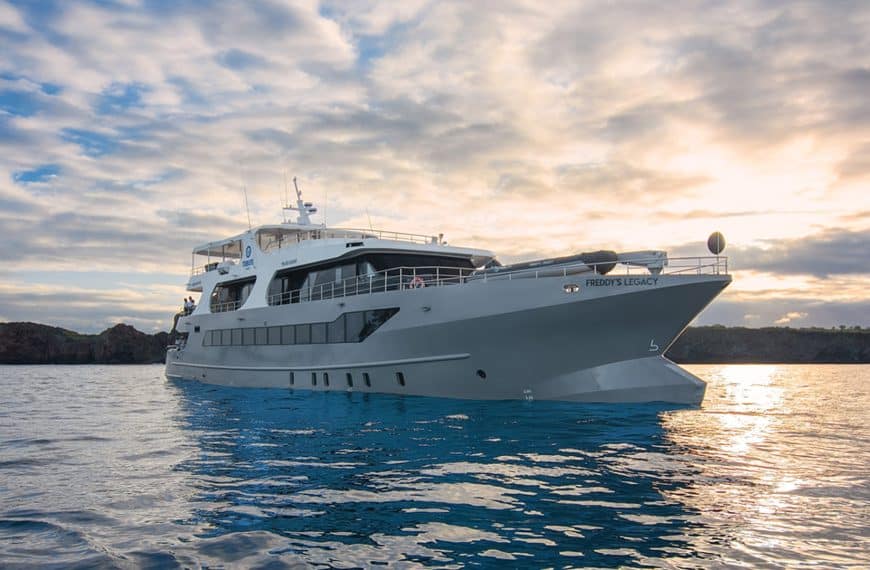
When you're spending upwards of a week on a Galapagos yacht with your family, the cabin arrangement isn't a minor detail — it's the difference between a seamless trip and a frustrating one. For families with young children, multigenerational groups, or anyone who simply wants more space, connecting suites transform a luxury cruise from "very good" to "this is exactly what we needed."
As local experts who book families onto these vessels every week, we know the cabin layouts intimately — which doors actually connect, which configurations work for which family sizes, and which connecting suites sell out months before the rest of the ship. This guide gives you the specific floor-plan details that most booking sites don't provide.
On a standard Galapagos cruise, families are spread across separate cabins on different decks. Parents are on the upper deck, the kids are on the main deck, and everyone meets at mealtimes. For couples or adult groups, this is perfectly fine. For families? It can be less than ideal.
Connecting suites solve three specific problems:
Proximity for young children. A connecting door between your suite and your children's cabin means you can check on them during the night without navigating steep ship stairways in the dark. For families with children under ten, this alone is worth the premium.
Shared living space. When two cabins connect, the combined area functions more like a small apartment than a hotel room. Children can move freely between the rooms. Parents get some separation without losing oversight. Everyone has space to spread out — and on a yacht where you're sharing public areas with other guests, that private family space becomes genuinely valuable.
Simplified logistics. Getting a family of four or five ready for a morning excursion is chaotic enough on land. On a yacht, when your cabins are on different decks and connected by narrow stairways, the logistics multiply. Connecting suites keep everyone in one place, which means faster mornings and calmer evenings.
 Vessel-by-Vessel Connecting Suite Breakdown
Not all "connecting cabins" are created equal. Some vessels have purpose-built connecting doors between suites. Others have adjacent cabins that can be unlocked to create a linked space. The differences matter, and here's what you need to know about three of the best options in the Galapagos luxury fleet.
The Infinity offers one of the most practical connecting configurations in the Galapagos fleet: a full suite that connects with a standard cabin next door, creating what we call a family apartment.
The suite is the standout space. It features panoramic windows that flood the room with natural light and ocean views, plus a separate living area with seating — a rarity on Galapagos vessels, where most cabins are essentially a bed and a bathroom. The living area gives you somewhere to sit together as a family that isn't the bed or the shared dining room upstairs.
The connecting standard cabin next door can be unlocked to create a direct passage between the two rooms. The standard cabin is smaller — it's a comfortable double with en-suite bathroom — but when combined with the suite, the total footprint is generous by Galapagos standards. Parents in the suite, children in the standard cabin, connecting door open: everyone has their space, nobody is far away.
Best for: Families of 3-4 (two adults, one or two children). The suite accommodates the parents with room to spare, and the standard cabin gives children their own bathroom and sleeping space while maintaining that critical connecting-door proximity.
The Sea Star takes a different approach: two full suites that connect to create a premium family space on the upper deck. This is the most luxurious connecting option available in the Galapagos.
The Sea Star Suite connects with the Galapagos Suite, and both are positioned on the upper deck — the best location on the vessel for views, light, and proximity to outdoor social areas. Critically, both suites have private balconies. When the connecting door is open, the family effectively has two balconies, two bathrooms, and two generous sleeping areas.
The upper deck location is particularly appealing for adult families or multigenerational groups where grandparents and parents want premium accommodation without being stacked on top of each other. The connecting door means you're as close or as separate as you choose — open it for family time, close it for privacy.
Best for: Families of 4-5 who want the highest tier of comfort, or multigenerational pairings (grandparents in one suite, parents in the other) who want luxury and connection in equal measure. This is also an excellent configuration for two couples traveling together — siblings with their respective partners, for instance.

The Hermes takes an entirely different design philosophy: all cabins are the same size. At first glance, this might seem less appealing than a dedicated suite vessel. In practice, it's one of the most flexible options for families.
Because every cabin is identical, any two adjacent cabins can function as a connected pair. There's no hierarchy of cabin types, no premium upcharge for a "suite" versus a "standard," and no competition for the one connecting configuration on the ship. If you need two connected cabins, the crew can accommodate this with whichever pair of adjacent cabins works best for the overall guest arrangement.
This uniformity also means larger families or family reunion groups can book multiple adjacent cabins and create a family block — three or even four cabins in a row, all on the same deck, all the same layout. For groups of six or more, this kind of flexible adjacency is more useful than a single connecting suite pair.
Best for: Larger families (5+) or multi-family groups who need several cabins close together. Also excellent for families who don't want to pay a suite premium but do want the connecting-cabin convenience. The uniform layout means you get connection without the luxury markup."Based on our experience, the Hermes offers adjacent cabins rather than internal connecting doors — each cabin has its own corridor entrance. For families, this still works well because the cabins are close together on the same deck, and the intimate size of the vessel means you are never more than a few steps from each other."
The right choice depends on your family size, composition, and priorities. Here's a quick framework.
The Infinity's suite-plus-standard configuration is purpose-built for this family shape. The suite gives parents the living space and panoramic views, the standard cabin gives children independence with proximity, and the connecting door makes bedtime and mornings simple. You get the luxury suite experience with the practical family layout.
The Sea Star's suite-to-suite connection offers the most space and the highest comfort tier. Two full suites with balconies is genuinely exceptional for a Galapagos vessel. If your family includes grandparents who want their own premium space with a connecting option to the next generation, this is the configuration to book.
The Hermes' uniform cabin design gives you the flexibility that fixed suite configurations can't. When you need three or four cabins together, the ability to create a family block of identical cabins on the same deck is more practical than one connecting suite pair plus scattered overflow cabins elsewhere on the ship.
Either the Sea Star (for luxury and balconies) or the Hermes (for simplicity and value). The Sea Star is the choice if you want to celebrate — anniversary trips, milestone birthdays. The Hermes is the choice if you want a great cruise without the premium pricing.
Here's something we tell every family enquiring about connecting suites: book early. And by early, we mean 10-14 months before departure.
Connecting suites are the first cabin configuration to sell out on every vessel, every departure. The reason is simple — there are very few of them. A vessel with 10 cabins might have only one connecting pair. Once that pair is booked, the next family wanting connected accommodation is out of luck on that departure.
For peak travel periods — June through September, Christmas and New Year, Easter week — 14 months is realistic. We've had families contact us 8 months ahead, convinced they were planning early, only to find their preferred connecting configuration was already taken on every departure in their date range.
A few tactical tips from our booking experience:

Luxury Galapagos yacht suites share certain amenities across the fleet, though the details vary by vessel.
Bathrooms. All three vessels featured here offer en-suite bathrooms in every cabin — you'll never share a bathroom with another cabin. Suites on the Infinity and Sea Star have larger bathrooms with premium fixtures. Hot water, rainfall showers, and quality toiletries are standard across the luxury tier.
Climate control. Individual air conditioning in every cabin. The Galapagos sits on the equator, and while the climate is milder than you'd expect (thanks to the Humboldt Current), afternoon temperatures can reach the high twenties, making air conditioning essential for comfortable sleeping.
Connectivity. Around 90% of Galapagos cruise vessels now have Starlink satellite internet. It's not fiber-optic-at-home speeds, but it's sufficient for messaging, email, and sharing photos. For families with teenagers, this can be the difference between enthusiasm and mutiny.
Dietary requirements. All Galapagos cruises accommodate dietary requirements — vegetarian, vegan, gluten-free, allergies. Communicate these when booking so the galley can prepare. This isn't a connecting-suite-specific feature, but families often ask, so: yes, your children's dietary needs will be met regardless of which cabin you book.
Storage. Suite-level cabins generally offer more wardrobe and drawer space than standard cabins. For families, this matters — children's gear, snorkeling equipment, sun protection, and the inevitable collection of "treasures" (volcanic rocks, shells found on the beach) all need somewhere to live.
We've booked families into connecting suites who told us afterwards that the cabin arrangement was the single thing that made the trip work. Not the wildlife (which was extraordinary). Not the itinerary (which was carefully chosen). The cabin.
Because when you're on a small yacht for five or eight days, your cabin is your home. It's where you decompress after a morning of snorkeling. It's where you get the children settled after dinner. It's where you sit on the balcony at sunset and watch frigatebirds wheel overhead while the children doze next door. The right cabin arrangement turns all of those moments from logistically stressful into effortlessly enjoyable.
That's why we spend so much time on cabin selection with our families. It's not about upselling you to a more expensive room. It's about understanding how your family actually lives and making sure the vessel layout supports that — rather than fighting against it.
Connecting suite availability changes weekly. The configurations described in this guide are accurate as of publication, but availability on specific departures shifts constantly. The best way to find the right connecting suite for your family is to tell us your dates, your family composition, and your priorities — and let us match you to what's currently available.
We've walked these cabins. We know which connecting doors are solid and which are thin. We know which deck locations are quieter and which catch the morning light. And we'll tell you honestly if a particular connecting configuration doesn't suit your family's needs, even if it's the most expensive option on the vessel.
Tell us your family size, travel dates, and cabin priorities — we'll find connecting suites that match.
USA & Canada: 1-773-280-9571
Ecuador: +593-987-004-404
Email: [email protected]