Here's the honest answer most travel companies won't give you: there is no bad time to visit the Galapagos with your family. The wildlife is extraordinary year-round, the water is swimmable in every month, and the islands don't have a "closed season." But the best time to visit Galapagos with family depends on what your family wants to see, when your children are out of school, and how your group handles heat, rain, and rough seas.
As local experts who live and work in Ecuador, we've helped families plan Galapagos trips in every month of the year. This guide focuses specifically on the family angle — not just what's happening in the islands each month, but how those conditions affect children, teenagers, grandparents, and the overall family experience.
Galapagos has two distinct seasons, and understanding them is the foundation for choosing your travel dates.
Air temperatures reach 28-31°C (82-88°F). The sea is warmer — around 24-26°C (75-79°F) — which makes snorkeling significantly more comfortable for children. Short, intense rain showers occur most afternoons, but they rarely last more than an hour and children generally find them exciting rather than miserable. The skies are dramatic, with towering cumulus clouds that make for spectacular photographs.
For families, the warm season's big advantage is the water temperature. Children who might shiver through a 20-minute snorkel in the cool season will happily stay in for forty-five minutes during January through April. Since snorkeling is often the highlight for kids — swimming with sea turtles, spotting reef sharks, watching marine iguanas feed underwater — warmer water meaningfully improves the family experience.
The trade-off: seas can be calmer but the air is more humid, and younger children may find the midday heat tiring during dry landings. Mosquitoes are also more active in the warm season, particularly in the highlands. Pack repellent.
Air temperatures drop to 22-25°C (72-77°F), and the ocean cools to 18-22°C (64-72°F). A persistent light mist called garua settles over the highlands, and the seas become choppier — particularly in August and September, which are the roughest months for crossings between islands.
For families, the cool season brings outstanding wildlife activity. This is when the Humboldt Current drives nutrient-rich water into the archipelago, and the marine life responds. Whale sharks appear near Darwin and Wolf (though these northern islands are dive-only, not family cruise destinations). Closer to the main islands, humpback whales pass through, sea lions are extremely active, and the sheer volume of fish attracts spectacular seabird feeding frenzies that children love to watch.
The trade-off: water temperature. Children under ten may need wetsuits for snorkeling in July through September, and some will decide the water is simply too cold. If snorkeling is a priority for your family, the warm season is more reliable.
The warmest months. Sea turtle nesting begins on the beaches — families can sometimes see turtles coming ashore at dusk, which is a genuinely unforgettable experience for children. Green sea turtles are mating in the shallows, easily visible while snorkeling. Land iguanas on the southern islands begin their nesting rituals. The warm water makes this the single best period for family snorkeling.
Family verdict: Excellent for water-loving families. The heat can be intense for long dry-landing hikes with younger children, so morning landings are preferable.
Marine iguana eggs hatch on Espanola and other southern islands — baby iguanas are tiny, fearless, and endlessly fascinating to children. The water is still warm. Waved albatross begin arriving on Espanola in April, and watching their elaborate courtship dance is one of the most remarkable wildlife spectacles in the Galapagos. Land birds are nesting and active, including Darwin's finches, which are easier to observe during breeding season.
Family verdict: March-April is arguably the best overall period for families. Warm water, baby animals, and nesting birds create a natural-history classroom that keeps children of all ages engaged. Easter holidays align perfectly.
A transition month. The heavy rains ease off, temperatures begin to cool, and the seas start to pick up. Blue-footed boobies begin their courtship displays — the famous "dance" that children find hilarious and adults find extraordinary. Sea lion pups born earlier in the year are now playful and curious, approaching snorkellers with genuine interest.
Family verdict: Still excellent. The cooling water is noticeable but not yet cold, and the wildlife activity is diverse.
The cool season settles in. This is peak season for international visitors, partly because Northern Hemisphere school holidays begin. The wildlife shifts: humpback whales begin their passage through the archipelago, seabird activity intensifies as the Humboldt Current brings food closer to shore, and the giant tortoises in the Santa Cruz highlands are more active in the cooler temperatures — easier to find and observe.
Blue-footed boobies are now nesting, and families can watch the full nesting cycle: eggs, fluffy white chicks, and protective parents. Nazca boobies are also nesting, and their colonies on Genovesa and Espanola are bustling and noisy — children love the chaos of a booby colony.

Family verdict: Outstanding wildlife. Pack layers for early morning pangas and wetsuits for snorkeling. The most stable vessels are worth prioritising in these months.
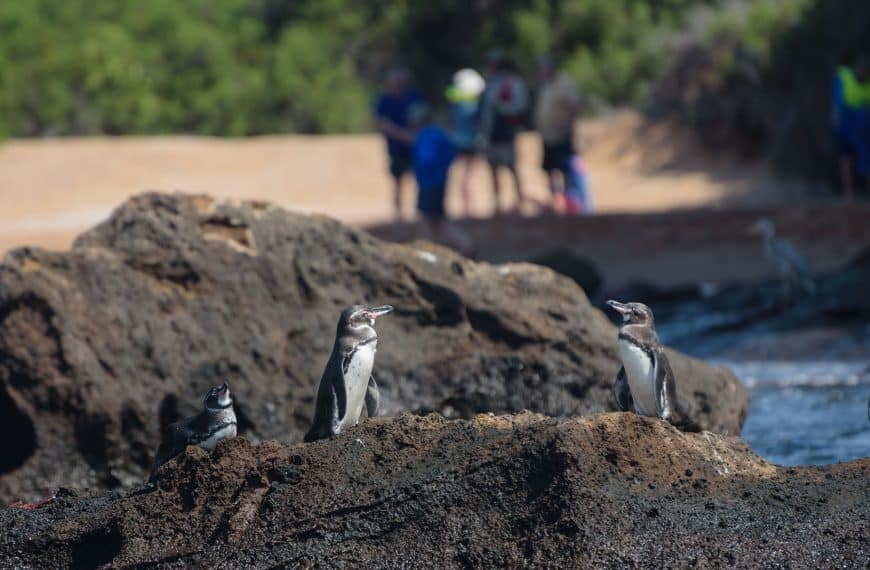
The roughest seas of the year, and the coolest water temperatures. This is when seasickness becomes a genuine consideration, particularly for children and older adults. However, the wildlife is spectacular: sea lions are at their most active, Galapagos penguins are breeding in the western islands, and enormous schools of fish attract seabird feeding frenzies that are visible from the ship's deck.
Whale sharks are present in the far northern islands (Darwin and Wolf), though these sites are accessible only to experienced divers, not family cruise itineraries.
Family verdict: Best for families with older children (12+) and strong stomachs. The wildlife is remarkable, but the sea conditions mean this isn't ideal for families with young children or anyone prone to motion sickness. If you do visit in these months, catamarans offer significantly more stability than monohulls.
The seas begin to calm, water temperatures start to rise, and the Galapagos enters a second transition period. Fur seals become more visible. Sea lion pups from the June-July birthing season are now old enough to be playful in the water, and snorkeling with juvenile sea lions is one of the purest joys the Galapagos offers — they'll spin around your children, blow bubbles, and generally show off.
Galapagos penguins are active and visible in the western islands. The garua mist lifts, and the islands begin to feel warmer and more inviting.
Family verdict: An underrated period. Crowds thin out after the Northern Hemisphere summer rush, availability improves, and the wildlife remains superb. Excellent value for families with flexible schedules.
The warm season returns. Water temperatures climb, the rains begin, and the islands turn green. Sea turtle nesting activity increases. Giant tortoises begin their migration from the highlands to lower nesting areas. Green sea turtles are easily spotted while snorkeling. Christmas and New Year bookings fill early, but the first two weeks of December offer excellent conditions with lower demand.
Family verdict: The water is warming up again, making snorkeling more accessible for younger family members. Early December is a hidden gem — post-cool-season wildlife activity with pre-holiday availability.
The practical reality for most families: you travel when school allows. Here's how the major school holiday windows align with Galapagos conditions.
Children don't care about your bird checklist. They care about animals that are big, funny, or interact with them. Here's when to visit for the species that consistently captivate kids:

Galapagos operates under a strict visitor management system — the national park limits the number of people at each landing site at any time. This means even in "peak season," you won't experience the kind of overtourism that plagues other destinations. A busy day in Galapagos means sharing a landing site with perhaps 30-40 other visitors. A quiet day means your family might have the beach nearly to themselves.
That said, vessel availability and pricing do vary by season:
For families booking from the UK or US, the shoulder months (April-May and October-November) consistently deliver the best combination of wildlife quality, comfortable conditions, and value.
Need help matching your school holiday dates to the right cruise?
We track availability across every vessel in the Galapagos fleet, and we know which routes deliver the best family experience in each month. Talk with an expert insider — we'll find the right dates and the right boat for your family.
Families with children under 10 who love snorkeling: January-April. The warm water is the deciding factor. Children will spend twice as long in the water during these months.
Birding and nature-focused families: June-July for peak cool-season activity, or April for the warm-season nesting spectacle. Both are outstanding — it depends whether you prefer marine abundance (cool season) or nesting behavior (warm season).
Multigenerational groups with mobility considerations: April-May or October-November. These shoulder months offer the calmest seas, most comfortable temperatures, and the gentlest conditions for older family members. Avoid August-September when seas are roughest.
Families with teenagers: June-August aligns with summer holidays and brings the most dramatic wildlife activity — feeding frenzies, whale sightings, active sea lion colonies. Teenagers respond to spectacle, and the cool season delivers it.
Families prioritising value: October-November or January-February. Lower demand means better availability on top-tier vessels and more competitive pricing. The wildlife doesn't know it's "off-peak."
Ready to plan your family's Galapagos trip?
As local experts, we know these islands in every season. Tell us your dates, your family's ages, and what matters most to you, and we'll design the perfect trip. Talk with an expert insider — we're here to help.