The Galapagos archipelago has 13 major islands, 6 smaller islands, and over 100 islets and rocks. No single cruise visits all of them. Each island has its own character, its own species, and its own surprises — so the question for families is: which islands deliver the best experiences for children?
What matters is a combination of terrain difficulty, wildlife density, snorkeling quality, and that hard-to-quantify factor: how much does this island make a child's eyes go wide? Here is our honest ranking, followed by advice on choosing an itinerary that covers the most family-friendly islands.
Before we rank individual islands, it helps to understand the logistics of visiting them, because this directly affects which islands work well for kids.
Every island visit is guided — your naturalist guide leads the group along marked trails, explains the wildlife, and ensures park rules are followed. Getting ashore means a zodiac landing, either dry (stepping onto a dock or rock) or wet (wading through knee-deep water onto a beach — young children may need to be carried). Most itineraries include a mix of both.
Trail difficulty ranges from flat sandy paths to rocky lava fields. We note the terrain for each island below. For families with mobility considerations, see our cruise accessibility guide.
Landing type: Dry | Terrain: Flat, rocky trail (easy) | Best ages: All ages 6+
Key wildlife: Magnificent frigate birds, blue-footed boobies, sea lions, land iguanas, swallow-tailed gulls
If we could only send a family to one island, it would be North Seymour. This small, low-lying island just north of Santa Cruz delivers the most reliable and concentrated wildlife experience in the entire archipelago.
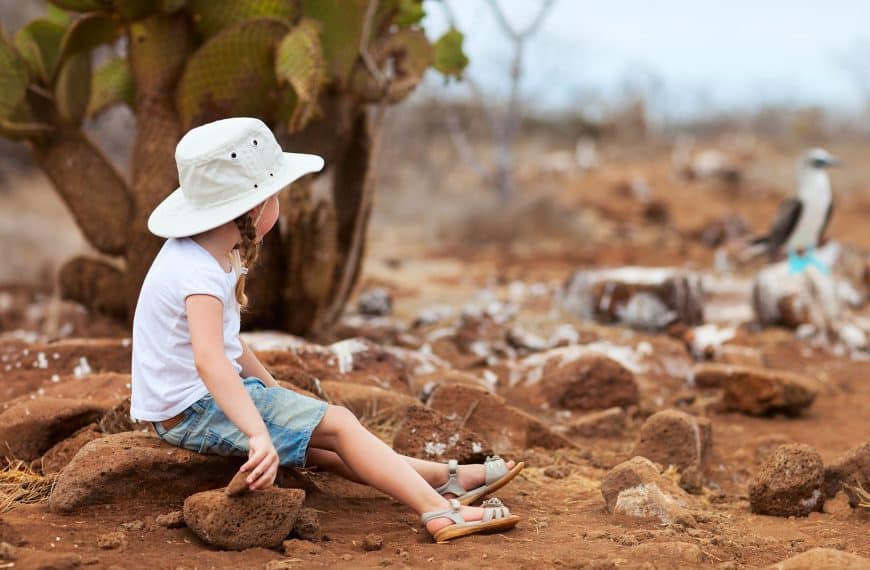
The trail is a flat loop of about 2 kilometers over rocky terrain. It is easy for children to walk, and the entire visit takes around 90 minutes. What makes North Seymour extraordinary is the sheer density of wildlife along that trail. You will walk past nesting magnificent frigate birds — the males with their iconic red throat pouches inflated like balloons during mating season. Blue-footed boobies perform their famous courtship dance just meters from the path. Sea lions lounge on the rocks at the landing site, completely unbothered by visitors.
For children, North Seymour is sensory overload in the best possible way. Everything they have read about or seen in documentaries is suddenly right there, close enough to see the texture of feathers, the color of a booby's feet, the whiskers on a sea lion pup's face. Bring your Big 15 checklist — your kids will tick off several species in a single visit.
North Seymour appears on many western and central itineraries, so it is relatively easy to find a cruise that includes it.
Landing type: Dry (harbour) | Terrain: Paved and easy trails | Best ages: All ages
Key wildlife: Giant tortoises (highlands), marine iguanas, Darwin's finches, sharks (at the fish market)
Santa Cruz is the hub of the archipelago, and nearly every itinerary stops here. The highlight for children is the Charles Darwin Research Station in Puerto Ayora, where the giant tortoise breeding program lets kids see tortoises at every stage of life — from tiny hatchlings to massive adults over a century old.
The Santa Cruz Highlands are equally essential. A short drive takes you to farmland where giant tortoises roam freely in their natural habitat — fundamentally different from an enclosure. Your children will watch these ancient creatures graze and bathe in ponds, and the scale (some weigh over 250 kilograms) is something no photograph captures.
Santa Cruz also offers Tortuga Bay, a stunning white-sand beach accessible via a 2.5-kilometre paved path, with a calm inner lagoon ideal for wading and spotting marine iguanas. See the Galapagos Insiders Santa Cruz guide for more.

Landing type: Wet | Terrain: Varied (easy beaches to moderate hikes) | Best ages: Ages 8+
Key wildlife: Galapagos penguins, flamingos, marine iguanas, sea turtles, flightless cormorants (western coast)
Isabela is the largest island in the archipelago — bigger than all the others combined — and it feels genuinely wild. The Tintoreras islet, just off the harbour, is an easy zodiac ride to a flat lava trail where you walk above channels filled with resting white-tip reef sharks, marine iguanas, and sea lions. Children find the shark-watching mesmerising — the animals are clearly visible in the clear, shallow water.
Concha de Perla, accessible from town, is a sheltered lagoon where families can snorkel independently among sea lions and colorful fish. Older children (10+) will enjoy the Wall of Tears hike — a moderate trek past lava tunnels and viewpoints to a sobering historical site.
Isabela's western coast, accessible only by cruise, is where you may encounter Galapagos penguins at close range and flightless cormorants drying their stubby wings on the rocks. See the full Isabela island guide.
Landing type: Wet (Gardner Bay), Dry (Punta Suarez) | Terrain: Flat to moderate, rocky in places | Best ages: Ages 8+
Key wildlife: Waved albatross (April-December), Nazca boobies, blue-footed boobies, marine iguanas, blowhole
Espanola is the southernmost island in the archipelago, and visiting it feels like stepping onto another planet. It is remote, raw, and home to some of the most dramatic wildlife encounters in the Galapagos.
The star attraction is the waved albatross, which nests exclusively on Espanola between April and December. These are enormous birds with wingspans of up to 2.5 meters, and their courtship dance — a synchronised routine of bill-clacking, bowing, and waddling — is one of nature's great performances. Children are spellbound. If your family visits between April and December, try to choose an itinerary that includes Espanola specifically for this.
The trail at Punta Suarez takes you past nesting Nazca boobies, colorful marine iguanas (Espanola's are uniquely red and green during breeding season), and the famous blowhole — a natural lava formation that shoots seawater up to 20 meters into the air when the swell is right. Children love the blowhole. It is loud, dramatic, and the spray catches in the sunlight.
Gardner Bay is one of the most beautiful beaches in the Galapagos — pristine white sand with sea lions scattered along the shore. The snorkeling here is excellent, with clear water and abundant fish. It is a perfect combination: wildlife spectacle at Punta Suarez in the morning, beach and snorkeling at Gardner Bay in the afternoon.
The terrain at Punta Suarez is rocky and uneven in places, so we recommend Espanola for families with children aged eight and above. For more, see the Espanola island guide.
Landing type: Dry | Terrain: 372 wooden steps to the summit viewpoint | Best ages: Ages 7+
Key wildlife: Galapagos penguins, reef sharks, rays, sea lions
Bartolome is a tiny volcanic island with the most photographed view in the Galapagos: the view from its summit looking down over Pinnacle Rock, with Sullivan Bay stretching out behind it. It looks exactly like the postcards, and your family photo from the top will be extraordinary.
Getting to the viewpoint requires climbing 372 wooden steps up a boardwalk path over barren volcanic landscape. It sounds daunting, but the steps are well-maintained and there are rest platforms along the way. Children aged seven and above manage it comfortably, and the sense of achievement at the top is genuine. The landscape itself — black and red lava, scattered pioneer plants, the vast Pacific Ocean — feels like being on Mars.
The real highlight for many children, though, is the snorkeling at the base of Pinnacle Rock. This is one of the best spots in the Galapagos to snorkel with Galapagos penguins. These small, fast birds dart through the water around you, and the experience of swimming alongside a penguin is something your child will never forget. White-tip reef sharks and rays are also commonly spotted. Our snorkeling guide for kids covers what to expect.
Bartolome appears on many northern and central itineraries and pairs well with nearby Sullivan Bay for a morning-afternoon combination.

Landing type: Dry | Terrain: Flat but rough lava, uneven footing | Best ages: Ages 10+
Key wildlife: Flightless cormorants, marine iguanas (huge colonies), Galapagos penguins, sea lions, hawks
Fernandina is the youngest, most volcanically active, and most pristine island in the Galapagos — no invasive species have ever established here. The single visitor site at Punta Espinoza is a narrow lava peninsula where the concentration of marine iguanas is staggering: hundreds piled on black rock, sneezing salt in the equatorial sun.
This is also one of the best places to see flightless cormorants — found nowhere else on Earth. Children are fascinated by the evolutionary story: why would a bird lose the ability to fly? Your guide will explain how the absence of predators made flight unnecessary over millions of years. This is evolution made visible.
We rank Fernandina sixth because it sits in the far west, meaning longer open-water crossings and rougher seas (especially July-November). The lava terrain requires sure footing. For children 10+ and families comfortable on the water, it is extraordinary. For younger kids or those sensitive to seasickness, save it for a return trip.
No single Galapagos cruise visits all of these islands — itineraries are set by the National Park and follow fixed routes. Here is how to think about itinerary selection as a family.
These typically include Isabela and Fernandina, plus North Seymour and sometimes Bartolome. Best for: families with older children who want the most diverse wildlife, including penguins and flightless cormorants. Be aware of rougher seas on the western crossings.
These typically include Espanola, San Cristobal, and sometimes Santa Fe or Floreana. Best for: families visiting April-December who want to see the waved albatross on Espanola. San Cristobal also has a wonderful interpretation center that children enjoy.
These focus on Santa Cruz, North Seymour, Bartolome, and nearby islands like South Plaza and Rabida. Best for: families with younger children (6-8) who want flatter terrain, reliable wildlife, and shorter crossings.
Many operators offer 8-day itineraries combining western and eastern routes for the greatest range. For younger children or shorter schedules, a 4- or 5-day central itinerary centerd on North Seymour and Santa Cruz is an excellent introduction. See our guides to the best boats for families and 2026 family cruise costs for help choosing a vessel.
We do not believe any Galapagos island is "bad" for families — every one has something remarkable. But some are better suited to older or more experienced travelers.
If you are traveling with children under 6, most cruise ships will not accept them on board. A land-based Galapagos trip from Santa Cruz or Isabela is the best alternative, giving you access to highlands tortoises, beaches, snorkeling, and the Darwin Station without the constraints of a cruise itinerary.

The Galapagos are one of the few places on Earth where children witness evolution, geology, and conservation in real time. Choosing the right islands ensures every day delivers something they will remember for the rest of their lives.
Need help choosing the right itinerary for your family?
Tell us your children's ages and what they are most excited to see. We will match you with itineraries that cover the best islands for your family — and recommend specific ships that suit your needs.